
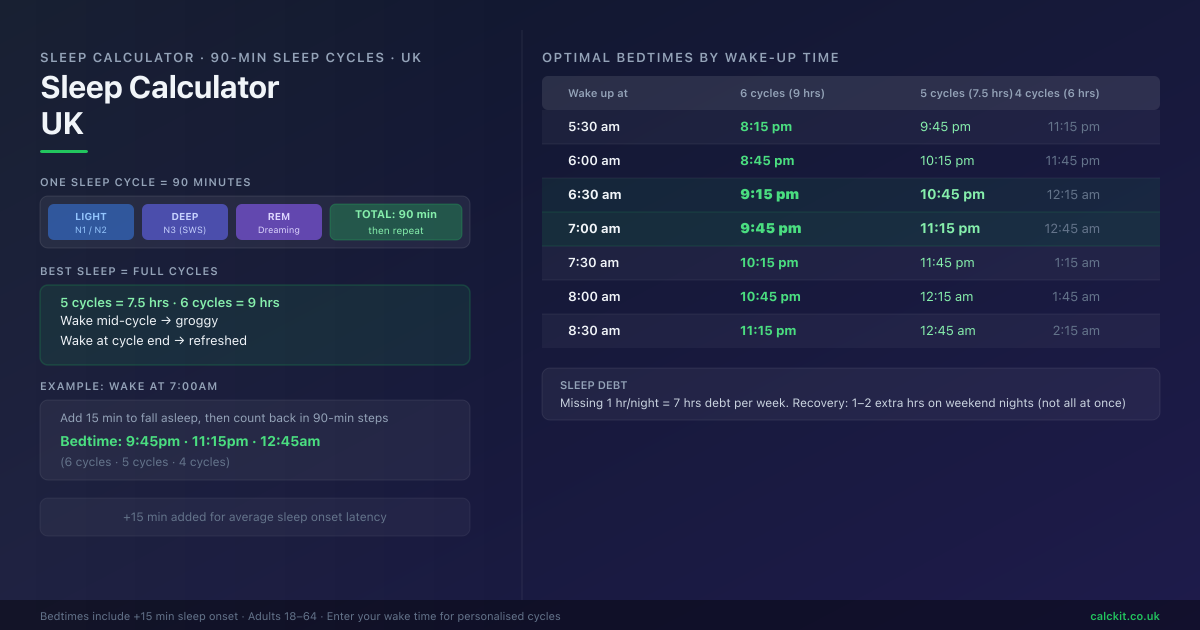
The best bedtime is not a fixed hour — it is calculated backwards from your wake-up time. Sleep arrives in 90-minute cycles, and waking at the end of a cycle feels dramatically better than waking in the middle of one. This guide explains the maths, gives a full bedtime lookup table, and covers sleep debt recovery.
😴How sleep cycles work
Each sleep cycle lasts approximately 90 minutes and passes through three distinct stages:
| Stage | Name | What happens |
|---|---|---|
| N1 | Light sleep | Transition from wakefulness; easily disturbed |
| N2 | Light sleep | Heart rate slows; body temperature drops; brain produces sleep spindles |
| N3 | Deep sleep (SWS) | Slow-wave sleep; hardest to wake from; physical restoration |
| REM | Rapid Eye Movement | Dreaming; memory consolidation; emotional processing |
A complete cycle runs N1 → N2 → N3 → REM, then repeats. Early cycles in the night contain more N3 deep sleep; later cycles contain more REM. This is why cutting sleep short by one or two hours disproportionately reduces REM — the stage that supports memory and mood.
The key rule: waking at the end of a cycle feels dramatically different to waking mid-cycle. At the end of a cycle, sleep is at its lightest. Mid-cycle, particularly during deep N3 sleep, your brain is in full slow-wave mode — waking from it causes sleep inertia: the groggy, disoriented feeling that can last 20–60 minutes.
Bedtime calculator table
The table below shows optimal bedtimes for each wake-up time. All times include 15 minutes to fall asleep (the average sleep onset latency for adults). Count back in 90-minute steps from there.
| Wake up at | 6 cycles (9 hrs) | 5 cycles (7.5 hrs) | 4 cycles (6 hrs) |
|---|---|---|---|
| 5:00 am | 7:45 pm | 9:15 pm | 10:45 pm |
| 5:30 am | 8:15 pm | 9:45 pm | 11:15 pm |
| 6:00 am | 8:45 pm | 10:15 pm | 11:45 pm |
| 6:30 am | 9:15 pm | 10:45 pm | 12:15 am |
| 7:00 am | 9:45 pm | 11:15 pm | 12:45 am |
| 7:30 am | 10:15 pm | 11:45 pm | 1:15 am |
| 8:00 am | 10:45 pm | 12:15 am | 1:45 am |
| 8:30 am | 11:15 pm | 12:45 am | 2:15 am |
| 9:00 am | 11:45 pm | 1:15 am | 2:45 am |
5 cycles (7.5 hours) is the recommended minimum for most adults. 6 cycles (9 hours) is ideal for recovery nights.
How to use the sleep calculator
The sleep calculator does this automatically for any wake time. You enter the time you need to wake up and it returns the bedtime options for 4, 5, and 6 complete cycles. You can also enter when you are going to sleep and it tells you the best wake times.
Manually:
- Take your wake-up time — say, 7:00am
- Subtract 15 minutes for sleep onset: 6:45am
- Count back in 90-minute steps: 6:45 → 5:15 → 3:45 → 2:15 → 12:45am → 11:15pm → 9:45pm
- The last three are your 4-, 5-, and 6-cycle bedtimes
NHS sleep recommendations by age
| Age group | Recommended sleep |
|---|---|
| School age (6–13) | 9–11 hours |
| Teenagers (14–17) | 8–10 hours |
| Adults (18–64) | 7–9 hours |
| Older adults (65+) | 7–8 hours |
Children's sleep cycles are shorter (around 50–60 minutes at birth, lengthening to adult duration by the mid-teens), so the 90-minute rule does not apply directly to children under 12. The child growth chart calculator covers age-related health benchmarks for children.
For adults, 7.5 hours (5 cycles) sits at the lower end of the NHS recommendation; 9 hours (6 cycles) is at the top. Consistently sleeping fewer than 7 hours raises the risk of impaired concentration, lowered immunity, weight gain, and over time, cardiovascular disease.
Sleep debt: the maths
Sleep debt accumulates at the daily shortfall rate. If you need 8 hours and get 6.5 hours, you add 1.5 hours of debt per night — 10.5 hours per week.
You cannot repay a week's debt in one long Saturday lie-in. Sleep research shows that cognitive performance, reaction times, and mood recover gradually over several nights of adequate sleep, not in a single recovery session. A very long single sleep-in also disrupts circadian rhythm, which makes the following nights harder.
How to pay off sleep debt:
- Add 1–2 extra hours per night for the first 2–3 nights (go to bed earlier rather than sleeping later)
- Aim for a bedtime that gives 5–6 full cycles
- Maintain a consistent wake time — even on weekends — to anchor your circadian rhythm
- Avoid sleeping more than 10 hours in a single night; it rarely helps and can leave you feeling worse
Why waking mid-cycle feels so bad
When you wake during deep N3 sleep, your brain is in slow-wave mode — large, slow delta waves dominate. The brain does not simply switch off like a light; it transitions gradually through lighter stages before fully waking. Pulling someone (or yourself, via an alarm) out of N3 forces an abrupt transition.
The result is sleep inertia: the grogginess, impaired reaction time, and difficulty thinking that can last anywhere from 15 minutes to over an hour. This is the feeling of waking at the wrong stage. It is not a sign of not having slept enough — it is a sign of waking at the wrong point in the cycle.
Aligning your alarm with a natural cycle end largely eliminates sleep inertia. Many people find that moving their alarm 15 minutes earlier or later makes a substantial difference to how they feel on waking.
Signs you are waking mid-cycle
If you consistently experience these, your alarm may be falling mid-cycle rather than at a cycle end:
- Strong grogginess that takes 30–60 minutes to clear
- Difficulty remembering the first 10 minutes after waking
- Feeling no better after 8 hours than after 7
- Reaching for the snooze button despite adequate total sleep
Adjusting your bedtime by 15–20 minutes in either direction can shift the alarm into a lighter sleep stage.
Frequently Asked Questions
Can I train myself to need less sleep?
No. Research consistently shows that people who claim to function well on 5–6 hours of sleep test significantly below their own rested baseline on cognitive performance measures — but they are unaware of the deficit because sleep deprivation also impairs self-assessment. Genuine short sleepers (people who function well on less than 6 hours) exist but are rare, estimated at under 3% of the population.
What if I cannot fall asleep within 15 minutes?
If you regularly take 30–45 minutes to fall asleep, your sleep onset latency is higher than average. This shifts all bedtime calculations by that extra time. The sleep calculator has an option to enter your personal sleep onset time so the bedtime recommendations account for it. Common causes of extended sleep onset include caffeine after 2pm, bright screen light in the hour before bed, an overly warm room, and irregular bedtimes.
Is a nap the same as a full sleep cycle?
A short nap (10–20 minutes) keeps you in N1 and early N2 — light sleep — and you wake feeling alert. A 30-minute nap risks entering N3 and waking from deep sleep with grogginess. A 90-minute nap completes one full cycle and can clear significant sleep debt. If you nap, aim for either under 25 minutes (power nap) or a full 90 minutes. Naps after 3pm disrupt night-time sleep onset for most people.
Last updated November 2026. Sleep cycle times and NHS recommendations based on current evidence reviewed by the Sleep Foundation and NHS guidelines.