
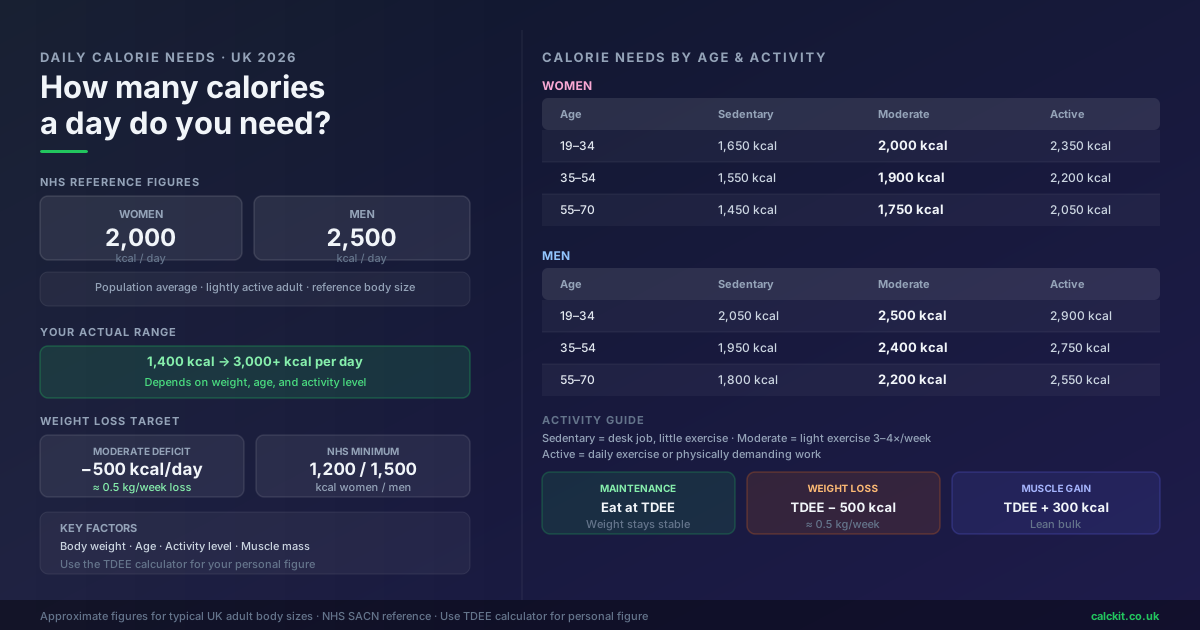
The NHS recommends 2,000 calories a day for women and 2,500 for men. These figures appear on food labels, in government guidelines, and across most calorie tracking apps in the UK. They are also, for most individuals, either an overestimate or an underestimate by several hundred calories.
🔥The NHS 2,000 and 2,500 kcal figures
The NHS reference values come from the Scientific Advisory Committee on Nutrition (SACN). They represent the estimated average requirement for a lightly active adult in the UK population — not a target for any specific person.
| NHS reference | Daily calories |
|---|---|
| Adult women | 2,000 kcal |
| Adult men | 2,500 kcal |
These figures assume:
- A "reference" adult body size (around 60 kg for women, 75 kg for men)
- Light activity — roughly equivalent to a desk job with some walking
- Working-age adults (approximately 19–64)
If you are smaller, older, or less active than this reference profile, your needs are lower. If you are larger, younger, or more active, they are higher.
What actually determines your calorie needs
Four factors drive your personal daily requirement:
1. Body size — A heavier body requires more energy to run, even at rest. A 90 kg person burns significantly more in a day than a 55 kg person doing identical activities.
2. Body composition — Muscle tissue burns about three times more calories at rest than fat tissue. Two people with the same weight but different proportions of muscle and fat will have different calorie needs.
3. Age — Calorie needs typically fall by around 1–2% per decade after age 30 as muscle mass naturally declines. By age 65, most people need 15–20% fewer calories than at age 25.
4. Activity level — The biggest variable. Someone who exercises intensively for two hours daily burns hundreds of calories more per day than someone in a sedentary job who takes the lift.
Calorie needs by age and activity level
These are approximate figures for typical UK adults. Actual needs vary by height and weight — use the TDEE calculator for a personalised figure.
Women:
| Age group | Sedentary | Moderately active | Active |
|---|---|---|---|
| 19–34 | ~1,650 | ~2,000 | ~2,350 |
| 35–54 | ~1,550 | ~1,900 | ~2,200 |
| 55–70 | ~1,450 | ~1,750 | ~2,050 |
Men:
| Age group | Sedentary | Moderately active | Active |
|---|---|---|---|
| 19–34 | ~2,050 | ~2,500 | ~2,900 |
| 35–54 | ~1,950 | ~2,400 | ~2,750 |
| 55–70 | ~1,800 | ~2,200 | ~2,550 |
Sedentary = desk job, little planned exercise. Moderately active = light exercise 3–4 days/week or active job. Active = exercise most days or physically demanding work.
⚡Calorie targets by goal
Once you know your maintenance calories (your TDEE), set your daily target from there:
| Goal | Adjustment | Weekly change |
|---|---|---|
| Lose weight (slow, sustainable) | TDEE − 500 kcal | ~0.5 kg/week |
| Lose weight (faster) | TDEE − 750 kcal | ~0.75 kg/week |
| Maintain weight | At TDEE | — |
| Gain muscle (lean bulk) | TDEE + 300 kcal | ~0.3 kg/week |
| Gain weight (faster) | TDEE + 500 kcal | ~0.5 kg/week |
NHS minimum safe intakes:
- Women: 1,200 kcal/day minimum
- Men: 1,500 kcal/day minimum
Eating below these figures without medical supervision leads to muscle loss, nutritional deficiencies, and your metabolism adapting downward — making future weight management harder.
Common sources of hidden calories
Tracking food accurately is harder than most people expect. The most commonly missed sources:
| Source | Approximate kcal |
|---|---|
| Cooking oil (1 tbsp, 15 ml) | 120 kcal |
| Large latte (whole milk) | 220–250 kcal |
| Pint of lager | 180–230 kcal |
| Peanut butter (2 tbsp) | 180 kcal |
| Orange juice (250 ml glass) | 110 kcal |
| Salad dressing (2 tbsp) | 100–150 kcal |
| Sports drink (500 ml) | 130–160 kcal |
Drinks are the most common source of untracked calories. A routine of two lattes, a glass of juice, and a glass of wine adds around 650 kcal before any food is counted.
Signs your intake is too low
Going below your calorie needs consistently — even by 200–300 kcal/day — can produce noticeable effects within a few weeks:
- Persistent fatigue and reduced concentration
- Increased hunger, particularly in the late afternoon
- Loss of strength during exercise
- Hair becoming thinner or shedding more than usual
- Feeling cold, particularly in hands and feet
- Irregular menstrual cycles (women)
If you are tracking calories carefully and experiencing these symptoms, your target may be set too low, or your TDEE estimate may be higher than calculated.
Frequently Asked Questions
Should I eat more on days when I exercise?
Exercise increases your calorie expenditure, and many people find their hunger naturally adjusts on training days. Whether you eat more on those days or average out your intake across the week is a personal preference — the total weekly calorie balance matters more than the distribution. Eating more on training days and less on rest days works well for some people; others prefer a consistent daily target.
Does the 2,000 kcal figure change if I am pregnant?
Yes. The NHS recommends an additional 200 kcal/day during the third trimester of pregnancy (not during the first or second trimester, contrary to popular belief). Breastfeeding requires an additional 300–500 kcal/day depending on feeding frequency. These are estimates — individual needs vary. Speak to your midwife or GP for personalised advice.
Last updated November 2026. Reference values based on UK NHS guidelines and SACN Dietary Reference Values for Energy (2011). Individual needs vary — table figures are population-level estimates for typical UK adult body sizes.