
Your resting heart rate is one of the simplest health numbers you can track — and one of the most meaningful. A GP can get a lot of information from 15 seconds of your pulse. It reflects how efficiently your heart is working, how stressed your nervous system is, and how your fitness level compares over time.
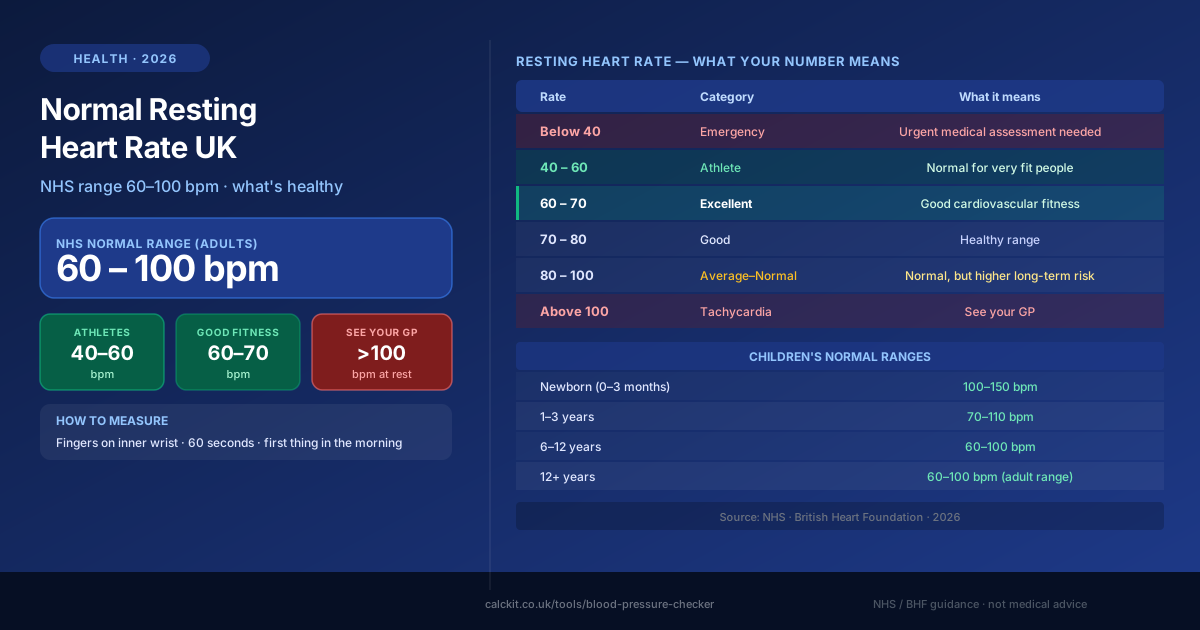
The NHS and British Heart Foundation both define the normal range as 60 to 100 beats per minute (bpm) for adults. But "normal" and "healthy" aren't quite the same thing. Research consistently shows that people whose resting heart rate sits in the lower half of that range — 60 to 70 bpm — have better long-term cardiovascular outcomes than those near the upper end.
Here's what the numbers mean, how to measure yours correctly, and when a fast or slow rate warrants a call to your GP.
🩺What Is a Normal Resting Heart Rate in the UK?
For adults aged 18 and over, the NHS puts the normal resting heart rate at 60 to 100 bpm. This is consistent with guidance from the British Heart Foundation (BHF) and international cardiology bodies.
A few important nuances:
- Women tend to run slightly higher than men. The BHF notes this is because women's hearts are usually smaller, meaning each beat pumps less blood — so the heart compensates with a slightly faster rate.
- Fitness makes a big difference. Regular aerobic training lowers your resting rate because a conditioned heart pumps more blood per beat. Elite endurance athletes can sit at 40–50 bpm and be perfectly healthy.
- The lower end of normal is generally better. Multiple large studies have found that a resting heart rate above 80–90 bpm (even within the "normal" range) is associated with higher risk of cardiovascular disease over time.
Resting Heart Rate by Fitness Level (Adults)
| Category | Resting Heart Rate |
|---|---|
| Athlete / very fit | 40–60 bpm |
| Good fitness | 60–70 bpm |
| Average | 70–80 bpm |
| Below average | 80–100 bpm |
| See your GP | Consistently above 100 bpm |
Source: British Heart Foundation / American College of Sports Medicine
These bands are guides, not diagnoses. A fit 25-year-old and a sedentary 65-year-old can both sit at 75 bpm and be in completely different health states. Context — symptoms, trends over time, medications — matters more than a single reading.
How to Measure Your Resting Heart Rate Accurately
The best time to measure is first thing in the morning, before you get out of bed.
Why? Coffee, movement, stress, and meals all raise your heart rate temporarily. A morning reading before any of those gives the cleanest baseline.
Method:
- Lie still for 5 minutes after waking (or simply take the reading before getting up)
- Place your first two fingers on the inside of your wrist, just below the base of your thumb (radial pulse)
- Alternatively, press gently on the side of your neck (carotid pulse) — this tends to be stronger
- Count the beats for 60 seconds — don't use the 10-second-times-6 shortcut if accuracy matters, as you'll amplify any counting errors
- Take three readings over three days and average them for a reliable figure
Smartwatches and fitness trackers are convenient but can be 5–10 bpm off compared to a manual reading. For clinical purposes, use the manual method.
Normal Resting Heart Rates for Children
Children's hearts beat faster than adults', and the normal range falls gradually with age:
| Age | Normal Resting Heart Rate |
|---|---|
| Newborn (0–3 months) | 100–150 bpm |
| 3–6 months | 90–120 bpm |
| 6–12 months | 80–120 bpm |
| 1–3 years | 70–110 bpm |
| 3–5 years | 65–110 bpm |
| 6–12 years | 60–100 bpm |
| 12–15 years | 60–100 bpm |
| 16+ years | 60–100 bpm (adult range) |
Source: NHS, British Paediatric Cardiology Association
If a child has a consistently fast rate with symptoms — pale skin, poor feeding, shortness of breath — contact your GP or call 111 rather than comparing to the table above.
⚕️What Raises Your Resting Heart Rate?
Many everyday factors push your resting rate upward, some of them temporarily:
Lifestyle factors:
- Caffeine — coffee, energy drinks, and some teas all stimulate your heart directly
- Alcohol — raises your rate temporarily; heavy drinking can cause persistent elevation
- Smoking — nicotine stimulates your sympathetic nervous system
- Dehydration — your blood volume drops, so the heart pumps faster to compensate
- Stress and anxiety — triggers the fight-or-flight response, flooding your system with adrenaline
- Poor sleep — inadequate rest keeps your nervous system in a heightened state
Health conditions:
- Fever or infection — your body raises heart rate to fight illness; this includes flu and Covid-19
- Anaemia — low red blood cell count means the heart works harder to deliver oxygen
- Overactive thyroid (hyperthyroidism) — one of the most common medical causes of persistent tachycardia
- Uncontrolled pain — chronic pain activates the same stress pathways as anxiety
Medications:
- Certain asthma inhalers (salbutamol/Ventolin) commonly cause a raised rate as a side effect
- Decongestants containing pseudoephedrine
- Some antidepressants
If your resting rate has gone up and you've recently started a new medication, mention it to your GP or pharmacist.
What Lowers Your Resting Heart Rate?
Regular aerobic exercise is by far the most effective way to lower your resting rate. Walking briskly, cycling, swimming, or any sustained cardio 3–5 times per week for 30+ minutes strengthens the heart muscle. Over 6–12 weeks, most people see a meaningful drop.
Other factors that help:
- Good sleep — 7–9 hours reduces stress hormone levels overnight
- Staying hydrated — adequate fluid volume means the heart doesn't have to compensate
- Healthy body weight — excess weight makes the heart work harder at rest; see what a healthy weight looks like by height
- Meditation and breathwork — activates the parasympathetic (rest-and-digest) branch of the nervous system
- Beta-blockers — if prescribed, these medications directly lower heart rate
The Difference Between Resting, Target, and Maximum Heart Rate
These three metrics serve different purposes:
Resting heart rate: Your baseline when fully at rest — the figure this article focuses on. Reflects overall cardiovascular fitness and health.
Maximum heart rate (MHR): The fastest your heart can beat. A rough estimate is 220 minus your age. A 40-year-old has an estimated MHR of 180 bpm. This is used to set exercise intensity zones.
Target heart rate zones: Percentages of your MHR used during exercise:
- Moderate intensity (zone 2): 50–70% of MHR
- Vigorous intensity (zone 3): 70–85% of MHR
- High-intensity interval training (zone 4/5): above 85%
A 40-year-old aiming for moderate-intensity exercise should keep their rate between 90–126 bpm during that session. Your resting rate has nothing to do with these targets directly — it's a separate measurement taken before activity.
⚡Bradycardia: When a Slow Heart Rate Is a Problem
Bradycardia means a resting heart rate below 60 bpm. In fit people, this is expected and healthy. In others, it can signal an issue with the heart's electrical system.
See your GP if you have a slow rate (under 60 bpm) AND:
- Dizziness or lightheadedness
- Fainting or near-fainting (syncope)
- Extreme fatigue, particularly on exertion
- Shortness of breath at rest
- Chest discomfort
If you're fit, exercise regularly, and feel well at a resting rate of 50 bpm — this is almost certainly sinus bradycardia, which is a completely normal adaptation to aerobic fitness.
Tachycardia: When a Fast Heart Rate Is a Problem
Tachycardia at rest means a rate consistently above 100 bpm. This should prompt a GP appointment.
Common causes include:
- Anxiety disorder or panic attacks
- Anaemia
- Hyperthyroidism
- Dehydration or poor electrolyte balance
- Heart rhythm problems (arrhythmias) such as atrial fibrillation
The BHF estimates around 2 million people in the UK live with some form of heart rhythm problem, and most can lead normal lives with appropriate treatment.
Seek emergency care (call 999) if:
- Your resting rate is above 150 bpm
- You have chest pain or pressure alongside a fast rate
- You feel faint, or you've collapsed
Heart Rate Variability: The Newer Metric
Heart rate variability (HRV) is the variation in the time gap between each heartbeat — and it's increasingly recognised as a more nuanced health marker than resting heart rate alone.
A healthy heart doesn't beat like a metronome. Small variations between beats (high HRV) indicate a well-regulated autonomic nervous system. Low HRV is associated with stress, poor recovery from exercise, and higher cardiovascular risk.
HRV is typically measured in milliseconds and varies significantly between individuals, making it less useful as a standalone figure compared to tracking your personal trend over time. Most modern fitness trackers and smartwatches (Fitbit, Garmin, Apple Watch) now track HRV overnight.
When to See Your GP About Your Heart Rate
Book a routine GP appointment if:
- Your resting rate is consistently above 100 bpm without an obvious cause
- Your rate is consistently below 60 bpm and you have any symptoms
- You notice your heart beating irregularly at rest
- Your resting rate has increased significantly from your usual baseline over weeks or months
Call 111 if:
- You have palpitations — a racing or fluttering heart — that are new, frequent, or getting worse
- The palpitations come with dizziness or feeling faint
Call 999 immediately if:
- Chest pain with a fast heart rate
- Sudden collapse or loss of consciousness
- Rate above 150 bpm at rest with any symptoms
Your blood pressure reading alongside your heart rate gives a more complete cardiovascular picture — GPs typically look at both together.
Key Figures at a Glance
| Reading | What It Means |
|---|---|
| Below 40 bpm | Requires urgent medical assessment |
| 40–60 bpm | Normal for very fit people; see GP if symptomatic |
| 60–70 bpm | Excellent — good cardiovascular fitness |
| 70–80 bpm | Good — within healthy range |
| 80–100 bpm | Normal, but higher end carries greater long-term risk |
| Above 100 bpm | See your GP |
| Above 150 bpm | Seek emergency care |
Tracking your resting heart rate over weeks and months matters more than any single reading. A sudden increase from your personal baseline — even if it stays within the 60–100 range — is worth investigating if it persists.
Last updated October 2026. Heart rate guidance from NHS and British Heart Foundation. For personal medical advice, consult your GP.