
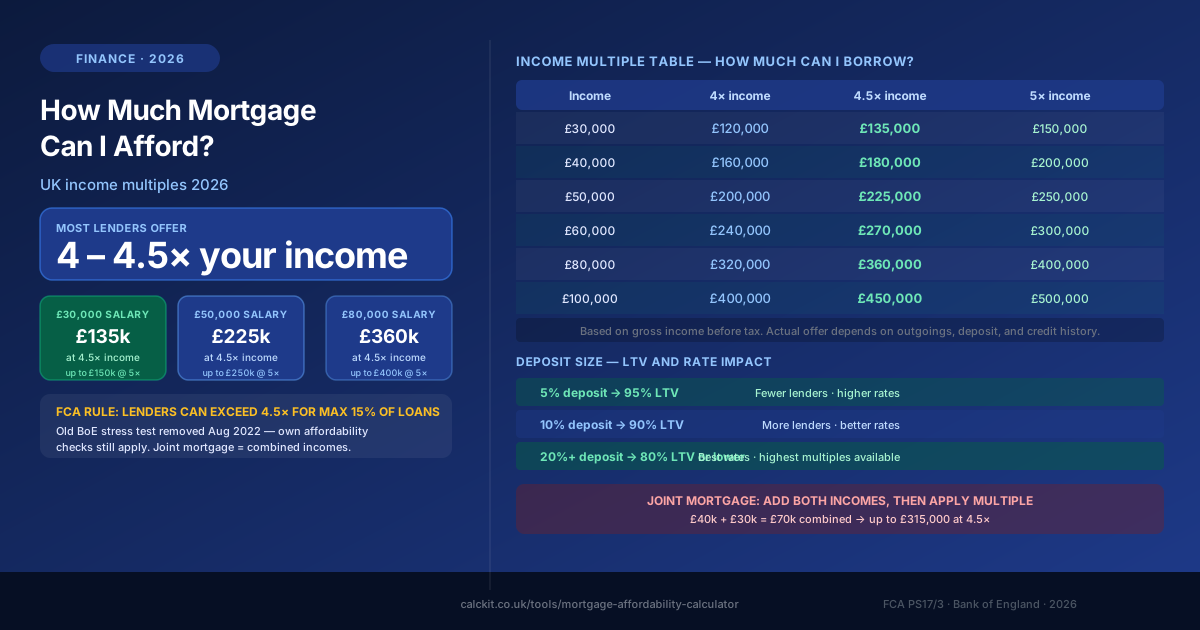
Most UK lenders will offer you somewhere between 4 and 4.5 times your gross annual income. That's the short answer, and it covers the majority of mortgage applications.
But the figure can be lower (if you have significant debt or poor credit), or higher (up to 5x, 5.5x, or even 6x from specialist lenders in the right circumstances). This guide covers the full picture: a salary-by-salary borrowing table, how joint mortgages change the numbers, what actually affects your ceiling, and when you can push past the 4.5x limit.
🏡How Much Can I Borrow? UK Income Multiple Table
Most lenders apply the income multiple to your gross annual income — your salary before tax, not your take-home pay. The table below shows typical borrowing ranges at three multiples:
| Gross income | 4× (lower end) | 4.5× (most common) | 5× (specialist / higher earners) |
|---|---|---|---|
| £25,000 | £100,000 | £112,500 | £125,000 |
| £30,000 | £120,000 | £135,000 | £150,000 |
| £35,000 | £140,000 | £157,500 | £175,000 |
| £40,000 | £160,000 | £180,000 | £200,000 |
| £50,000 | £200,000 | £225,000 | £250,000 |
| £60,000 | £240,000 | £270,000 | £300,000 |
| £75,000 | £300,000 | £337,500 | £375,000 |
| £80,000 | £320,000 | £360,000 | £400,000 |
| £100,000 | £400,000 | £450,000 | £500,000 |
These are starting estimates based on income alone. The actual offer will vary by lender, deposit size, monthly outgoings, credit history, and the property's loan-to-value ratio.
Important: the 4.5× figure is a regulatory limit on the lender's mortgage book, not a promise to every borrower. Your actual offer can be lower if your outgoings are high.
Joint Mortgages: Combined Income
In a joint application, lenders add both incomes together before applying the multiple. This is one of the most effective ways to borrow more:
| Partner 1 income | Partner 2 income | Combined | 4× | 4.5× |
|---|---|---|---|---|
| £30,000 | £25,000 | £55,000 | £220,000 | £247,500 |
| £40,000 | £30,000 | £70,000 | £280,000 | £315,000 |
| £50,000 | £40,000 | £90,000 | £360,000 | £405,000 |
| £60,000 | £50,000 | £110,000 | £440,000 | £495,000 |
Both applicants' credit histories and outgoings are assessed. If one partner has significant debt or a poor credit record, a joint application can sometimes reduce the offer rather than increase it — worth checking individually first.
💷What the FCA Income Multiple Rule Actually Means
The 4.5× cap comes from a Bank of England Financial Policy Committee rule, enforced by the FCA: lenders cannot offer more than 4.5× income on more than 15% of their new mortgage lending. This is a portfolio limit, not a per-borrower limit.
What it means in practice:
- Most lenders set 4.5× as their standard ceiling for individual borrowers
- Lenders can — and do — exceed 4.5× for qualifying applicants, up to their permitted 15% allocation
- Some lenders reserve 5× for higher earners or professionals; others offer it more broadly
The old Bank of England affordability stress test (which required checking that borrowers could afford repayments if rates rose 3 percentage points) was removed in August 2022. Lenders still run their own affordability assessments and must meet FCA rules — the specific BoE test is gone, but affordability checks remain.
What Lenders Actually Assess
Income multiples are a starting point. Every lender runs a full affordability assessment before making a mortgage offer. The key factors:
Income
- Employed applicants: lenders use basic salary, usually verified with payslips and P60. Some include guaranteed bonuses (often at 50% of average); others exclude them
- Self-employed: typically the last 2–3 years of accounts or tax returns; the lower or average figure is usually used, not the best year
- Variable income: commission, freelance, rental income — treatment varies widely by lender; some exclude it, others include a portion
Committed Outgoings
These reduce your borrowing capacity directly. Lenders check:
- Existing loan or credit card repayments
- Car finance
- Student loan deductions (Plan 2: 9% of income above £27,295)
- Childcare costs
- Other monthly commitments
Paying off a £200/month car loan before applying can meaningfully increase your mortgage offer.
Credit History
A clean credit record gives access to more lenders and often higher income multiples. County court judgements (CCJs), missed payments, or a high credit utilisation rate typically reduce the offer or limit you to fewer lenders.
Number of Dependants
More dependants = higher assumed living costs = lower mortgage offer. This is built into each lender's affordability model.
Loan-to-Value (LTV)
LTV is the mortgage as a percentage of the property value. A £180,000 mortgage on a £200,000 property = 90% LTV. Higher LTV (lower deposit) means:
- Fewer lenders to choose from
- Higher interest rates
- Potentially stricter affordability checks
Deposit Size and What It Changes
Your deposit is the part of the property price you pay upfront. The minimum is typically 5% — but bigger helps more than most first-time buyers expect:
| Deposit | LTV | What it means |
|---|---|---|
| 5% (£10,000 on £200k) | 95% | Fewer lenders; higher rates; restricted multiples at some lenders |
| 10% (£20,000 on £200k) | 90% | More lenders; better rates; standard multiples apply |
| 15% (£30,000 on £200k) | 85% | Wider range of competitive deals |
| 20–25% (£40–50k on £200k) | 75–80% | Best rates; most lenders available; higher multiples more accessible |
| 40%+ | 60% | Lowest rates available; maximum lender flexibility |
A larger deposit also reduces your monthly payment, which helps the affordability assessment. A £200,000 mortgage at 4.5% over 25 years costs about £1,109/month; the same property with a 20% deposit requires a £160,000 mortgage at a lower rate — roughly £867/month.
When Can I Borrow More Than 4.5×?
Some lenders will go to 5x, 5.5x or 6x in the right circumstances. The typical criteria:
5× income: available from a number of mainstream and specialist lenders. Commonly requires:
- Income above £50,000–£75,000 (varies by lender)
- A clean credit record
- Low committed outgoings
- Deposit of at least 10%
5.5× or 6×: usually from specialist or professional mortgage lenders only. Commonly requires:
- A qualifying profession (doctor, lawyer, accountant, dentist, architect, engineer, vet)
- Income above £75,000 per applicant or combined
- Typically 10–20% deposit
- Excellent credit
Examples of lenders known to offer above 4.5× for qualifying applicants include Halifax (First Time Buyers), Nationwide, and various specialist/professional mortgage lenders — but terms change; a mortgage broker has access to the full market.
Steps to Increase Your Mortgage Borrowing
If the standard multiple doesn't reach your target property price, practical steps that can help:
- Pay down existing debt — removing a £150/month car loan or credit card before applying frees up significant affordability headroom
- Save a larger deposit — moving from 90% to 85% LTV often opens access to lenders with higher multiples
- Add a second applicant — joint income is added before the multiple is applied
- Improve your credit score — clearing a high credit utilisation rate or settling defaults widens your lender options
- Wait for a pay rise or promotion — income verified at application; a pay increase locked in now changes the calculation
- Use a mortgage broker — brokers have access to the whole market and can identify lenders who will assess your profile more favourably
What You'll Pay Each Month
Borrowing a set amount is only part of the picture. Monthly payments depend on the interest rate and term:
| Mortgage | Rate (4.5%) | 25-yr term | 30-yr term |
|---|---|---|---|
| £135,000 | 4.5% | £747/mo | £684/mo |
| £180,000 | 4.5% | £996/mo | £912/mo |
| £225,000 | 4.5% | £1,245/mo | £1,140/mo |
| £270,000 | 4.5% | £1,494/mo | £1,368/mo |
| £360,000 | 4.5% | £1,991/mo | £1,824/mo |
Illustrative only — actual rate depends on deposit size, credit profile, and product type. Use the mortgage affordability calculator for a personalised figure.
Monthly payments above roughly 35–40% of your net take-home pay are a common personal affordability warning sign, even if a lender approves the mortgage. The take-home pay calculator shows your actual net income to check this ratio.
Last updated October 2026. Income multiple figures reflect standard UK lender practice and the FCA's LTI flow limit rules (PS17/3). The Bank of England affordability stress test was removed in August 2022. Actual mortgage offers depend on the lender's own criteria, affordability assessment, and market conditions. This article is for information only; for personalised advice, consult a whole-of-market mortgage broker.