
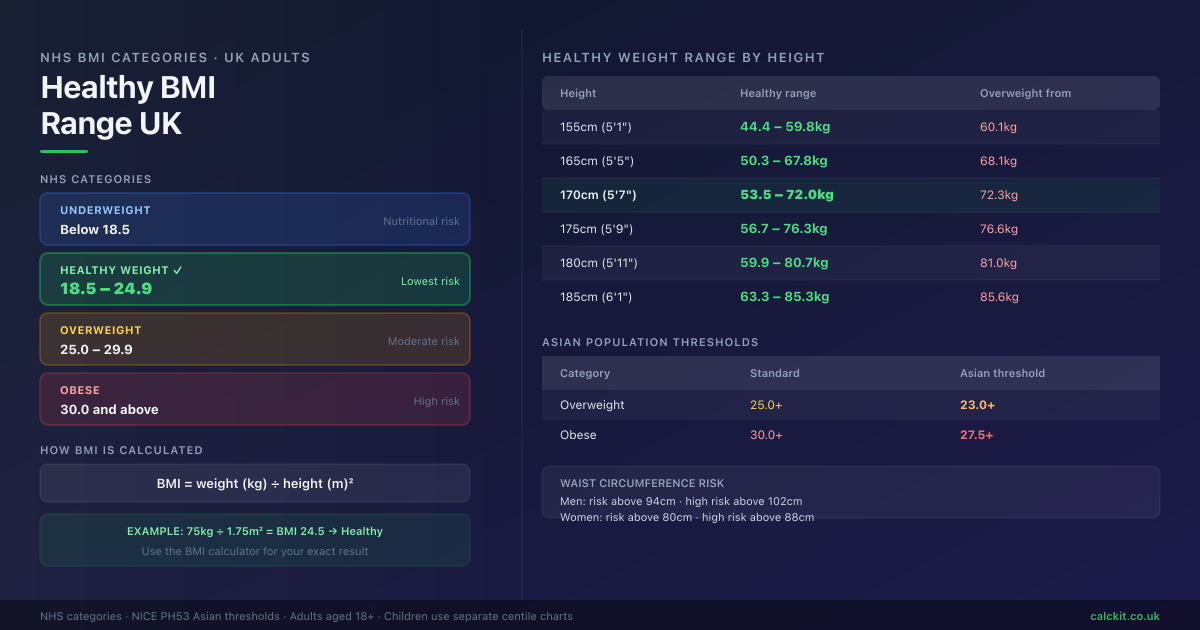
The NHS defines four BMI categories for UK adults. The healthy range is 18.5 to 24.9 — this is the range where, at a population level, weight-related health risk is lowest. Below 18.5 is underweight, 25 to 29.9 is overweight, and 30 or above is obese.
⚕️The four NHS BMI categories
| BMI | Category | Health risk |
|---|---|---|
| Below 18.5 | Underweight | Nutritional deficiency, bone density, fertility |
| 18.5–24.9 | Healthy weight | Lowest weight-related risk |
| 25.0–29.9 | Overweight | Moderate increased risk |
| 30.0–34.9 | Obese — Class I | High risk |
| 35.0–39.9 | Obese — Class II | Very high risk |
| 40.0 and above | Obese — Class III | Extremely high risk |
These ranges apply to adults aged 18 and over and use the same thresholds for men and women.
How BMI is calculated
BMI uses two measurements: your weight in kilograms and your height in metres.
BMI = weight (kg) ÷ height (m)²
Example: Someone who weighs 75 kg and is 1.75 m tall has a BMI of: 75 ÷ (1.75 × 1.75) = 75 ÷ 3.0625 = 24.5 — healthy weight.
The BMI calculator does this calculation instantly, including the NHS category and whether Asian thresholds apply.
Healthy weight range by height
The table below shows the weight range that falls within the healthy BMI band (18.5–24.9) for common heights.
| Height | Healthy weight range | Overweight starts at |
|---|---|---|
| 155cm (5'1") | 44.4–59.8kg | 60.1kg |
| 160cm (5'3") | 47.4–63.7kg | 64.0kg |
| 165cm (5'5") | 50.3–67.8kg | 68.1kg |
| 170cm (5'7") | 53.5–72.0kg | 72.3kg |
| 175cm (5'9") | 56.7–76.3kg | 76.6kg |
| 180cm (5'11") | 59.9–80.7kg | 81.0kg |
| 185cm (6'1") | 63.3–85.3kg | 85.6kg |
Figures rounded to one decimal place. Healthy BMI = 18.5–24.9.
Asian BMI thresholds
For adults of South Asian, Chinese, Japanese, or other Asian origin, the NHS recommends lower BMI thresholds. Research shows that at the same BMI, people from these populations tend to carry more body fat — particularly around the abdomen — which raises metabolic risk at a lower weight.
| Category | Standard threshold | Asian threshold |
|---|---|---|
| Healthy weight | 18.5–24.9 | 18.5–22.9 |
| Overweight | 25.0–29.9 | 23.0–27.4 |
| Obese | 30.0 and above | 27.5 and above |
These lower thresholds apply to people of South Asian descent (Indian, Pakistani, Bangladeshi, Sri Lankan) and other Asian groups including Chinese, Malay, and Japanese. The NHS recommends that GPs use these thresholds when advising patients from these backgrounds.
BMI limitations
BMI is a screening tool, not a diagnosis. It measures the ratio of weight to height but cannot distinguish between fat mass and muscle mass. This creates two common distortions:
Overestimates risk in muscular people. An athlete or someone who does heavy resistance training may have a BMI of 26–28 from muscle rather than fat. Their metabolic health may be excellent despite being classified as overweight.
Underestimates risk in some cases. A person who is sedentary with low muscle mass may have a BMI within the healthy range but carry an elevated proportion of body fat — particularly around the abdomen — which raises health risk.
Waist circumference alongside BMI gives a more complete picture. The NHS considers a waist above 94cm (men) or 80cm (women) to indicate increased risk, and above 102cm (men) or 88cm (women) to indicate high risk — regardless of BMI.
⚡What to do if your BMI is outside the healthy range
If underweight (below 18.5): Speak to your GP. Unintentional weight loss or persistent underweight can have nutritional, hormonal, or psychological causes that need assessment. The NHS recommends not trying to gain weight without advice if you are significantly underweight.
If overweight (25–29.9): Small reductions in weight — 5 to 10% of body weight — produce meaningful health benefits even without reaching the healthy range. The NHS recommends starting with dietary changes and increased physical activity rather than any specific diet programme.
If obese (30 and above): Your GP can refer you to NHS weight management services, including tier 2 and tier 3 programmes depending on your BMI and existing health conditions. NHS prescription weight-loss medications (orlistat, and from 2024 GLP-1 receptor agonists via specialist pathways) may be available depending on eligibility.
Children and teenagers
The NHS does not apply adult BMI ranges to children. For anyone under 18, BMI is plotted on age- and sex-adjusted centile charts — the same charts used for height and weight. The classifications are:
- Underweight: below the 2nd centile
- Healthy: 2nd to 91st centile
- Overweight: 91st to 98th centile
- Obese: above the 98th centile
The child growth chart calculator handles these centile calculations for children up to age 18.
Frequently Asked Questions
Can I be healthy at a BMI over 25?
Yes. BMI 25–27 is classified as overweight, but health risk at this level is modest and varies significantly between individuals. Fitness level, diet quality, waist circumference, blood pressure, and blood glucose are all more directly relevant to metabolic health than BMI alone. Many people at BMI 25–27 with good fitness markers have lower health risk than sedentary individuals at BMI 22.
What BMI do I need to be for surgery or fertility treatment on the NHS?
Eligibility criteria vary by procedure and NHS trust. Many trusts require a BMI below 30 for elective surgery and below 35 for fertility treatment (IVF), though thresholds differ. Some bariatric surgery programmes require a BMI above 40, or above 35 with obesity-related conditions. Your GP or referring consultant will advise on the specific criteria for your situation.
Last updated November 2026. BMI categories follow NHS and NICE guidance. Asian thresholds based on NICE Public Health Guideline PH53 and WHO Expert Consultation recommendations.