
Your GP hands you a slip of paper. It reads 142/88 mmHg. The nurse says "slightly elevated" and books you in for a follow-up. You leave none the wiser about what those two numbers mean, why both matter, or what happens next.
This guide closes that gap — what systolic and diastolic actually represent, the third number most people don't know exists (pulse pressure), why a single clinic reading can mislead, and the full NHS pathway from first reading to treatment.
For the NHS categories themselves — what counts as normal, low, high, and crisis — see our blood pressure ranges guide.
🩺What the two numbers actually mean
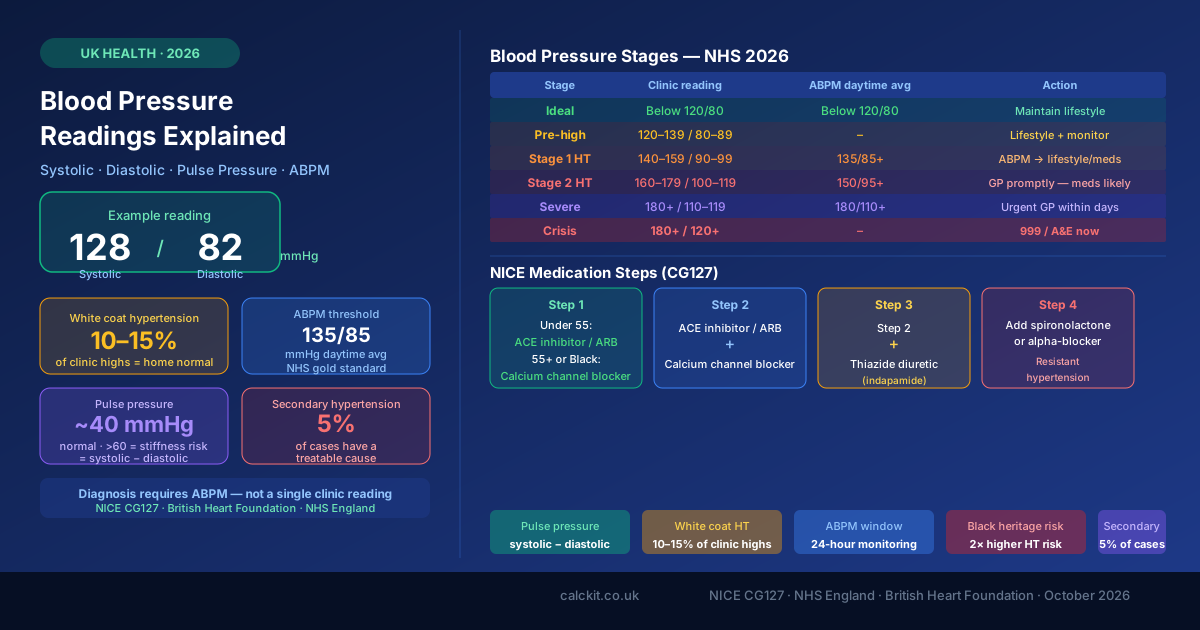
Every blood pressure reading is expressed as two numbers over each other, for example 128/82 mmHg (millimetres of mercury — the unit used because early blood pressure instruments were mercury manometers).
Systolic (top number) — the pressure inside your arteries at the exact moment your heart contracts and forces blood into your circulatory system. This is the peak pressure your arterial walls experience with each heartbeat.
Diastolic (bottom number) — the pressure in your arteries when your heart is relaxed between beats, refilling with blood before the next contraction. This is the baseline, resting pressure.
Neither number is "more important" in isolation, but in adults over 50, systolic pressure is generally the stronger predictor of future cardiovascular events. Below 50, diastolic pressure carries more predictive weight.
What mmHg means
mmHg stands for millimetres of mercury. A blood pressure of 120 mmHg means your blood exerts enough force to push a column of mercury 120 mm up a tube. The unit is universal in blood pressure measurement even though modern monitors use pressure sensors, not mercury.
The third number nobody tells you about: pulse pressure
Pulse pressure = systolic minus diastolic.
For a reading of 130/80, pulse pressure = 130 − 80 = 50 mmHg.
| Pulse pressure | What it suggests |
|---|---|
| 25–40 mmHg | Low — can indicate poor heart output or dehydration |
| 40–60 mmHg | Normal range |
| Above 60 mmHg | Elevated — possible arterial stiffness |
| Consistently above 60 in over-60s | Independent cardiovascular risk factor |
A normal pulse pressure is around 40 mmHg. High pulse pressure (above 60 mmHg) reflects arteries that have lost some of their elasticity — a condition called arterial stiffness. Stiff arteries can't absorb the pressure wave from each heartbeat as effectively, which forces systolic pressure higher while diastolic stays stable or falls.
High pulse pressure is an independent risk factor for stroke, heart failure, and kidney disease, separate from the absolute level of your readings. It's one reason GPs look at both numbers, not just the top one.
Why a single clinic reading may not reflect reality
The NHS and NICE do not diagnose hypertension from a single clinic reading. Here is why.
White coat hypertension
Approximately 10–15% of people who show elevated readings in a GP surgery have completely normal blood pressure in daily life. The technical term is white coat hypertension — blood pressure elevated by the anxiety of a clinical environment.
A reading taken by a stranger in a clinical setting can transiently raise systolic pressure by 10–30 mmHg in susceptible individuals. Treating white coat hypertension with medication is both unnecessary and harmful (it can cause dangerous drops in blood pressure at home).
Masked hypertension
The reverse also exists: masked hypertension, where blood pressure appears normal in a clinic but is consistently elevated in everyday life. Because it escapes detection at routine appointments, it carries a higher-than-expected cardiovascular risk. It is particularly common in people who experience work stress, those with anxiety disorders, and regular heavy drinkers.
Other factors that distort a single reading
- Caffeine in the previous 2 hours (raises systolic by ~5–8 mmHg)
- Exercise in the previous 30 minutes
- Full bladder (raises reading by ~10–15 mmHg)
- Unsupported back or crossed legs during measurement
- Talking during measurement
- Cold temperatures
This is why the NHS always uses multiple readings and, where possible, ambulatory monitoring before making a diagnosis.
Ambulatory blood pressure monitoring (ABPM) — the NHS diagnostic standard
NICE guideline CG127 (Hypertension in adults) recommends ambulatory blood pressure monitoring (ABPM) to confirm any diagnosis of hypertension in adults. It is the UK gold standard.
⚕️How it works:
You wear a portable monitor with a cuff on your upper arm for 24 hours. The monitor inflates automatically:
- Every 30 minutes during waking hours
- Every 60 minutes overnight
The device records each reading. Your GP receives the average daytime readings, overnight readings, and a 24-hour average.
ABPM thresholds:
| Setting | High blood pressure threshold |
|---|---|
| Clinic | 140/90 mmHg or above |
| Home monitoring (average) | 135/85 mmHg or above |
| ABPM daytime average | 135/85 mmHg or above |
| ABPM 24-hour average | 130/80 mmHg or above |
ABPM is preferred because it captures your real-world average across hundreds of readings in normal conditions — not a single measurement taken during a potentially stressful appointment.
If ABPM is not tolerated or available, home blood pressure monitoring (HBPM) is the alternative — taking two readings morning and evening for 7 days and averaging the results (excluding day 1).
What blood pressure stages mean in practice
| Stage | Clinic reading | What typically happens |
|---|---|---|
| Ideal | Below 120/80 | No action needed. Maintain healthy lifestyle. |
| Pre-high (elevated) | 120–139 / 80–89 | Lifestyle changes. Monitoring at intervals. |
| Stage 1 hypertension | 140–159 / 90–99 | ABPM to confirm. Lifestyle changes. Medication if risk factors present. |
| Stage 2 hypertension | 160–179 / 100–119 | Medication usually offered promptly alongside lifestyle changes. |
| Severe hypertension | 180+ / 110–119 | Urgent assessment within days. |
| Hypertensive crisis | 180+ / 120+ | Call 999. Go to A&E. Requires immediate management. |
For detailed ranges and age-specific context, see our blood pressure ranges guide.
The NHS treatment pathway: what happens after diagnosis
Step 1: Lifestyle first
Before or alongside medication for Stage 1 hypertension, GPs assess total cardiovascular risk using QRISK3 — a risk score based on age, cholesterol, blood pressure, family history, ethnicity, and other factors. If your 10-year cardiovascular risk is below 10% and you have no organ damage, lifestyle changes alone may be tried first.
Step 2: Medication — the NICE step approach
If medication is needed, NICE recommends a step approach:
Step 1:
- Under 55 or with type 2 diabetes: ACE inhibitor (ramipril, lisinopril) or ARB (losartan, candesartan)
- Aged 55+ or of Black African or Caribbean heritage: calcium channel blocker (amlodipine, felodipine)
Step 2: ACE inhibitor or ARB plus a calcium channel blocker
Step 3: ACE inhibitor or ARB + calcium channel blocker plus a thiazide-like diuretic (indapamide, chlortalidone)
Step 4 (resistant hypertension): Add spironolactone if potassium is below 4.5 mmol/L, or an alpha/beta-blocker. Consider specialist referral.
Why different drugs for different ages? ACE inhibitors work primarily by blocking the renin-angiotensin system, which is more active in younger people. Calcium channel blockers work by relaxing blood vessel walls and are more effective in older adults and people of Black African/Caribbean heritage, whose hypertension tends to involve lower renin activity.
Ethnic and genetic risk factors
High blood pressure is not equally distributed across the UK population.
Black African and Caribbean heritage: People of Black African or Caribbean background are roughly twice as likely to develop hypertension compared to white European populations, and typically develop it earlier and at more severe levels. Their hypertension tends to respond better to calcium channel blockers than to ACE inhibitors alone — which is reflected in the NICE step approach above. They also face a higher risk of stroke from hypertension.
South Asian heritage: People of South Asian background have elevated cardiovascular risk overall, which can make the impact of hypertension more serious even at moderate reading levels.
Family history: Having a parent or sibling with hypertension roughly doubles your own lifetime risk. The genetic component of blood pressure is significant — studies suggest 30–60% heritability.
Secondary hypertension: when there's a treatable cause
About 5% of people with high blood pressure have secondary hypertension — a specific, identifiable cause that can potentially be treated or removed.
| Cause | How common | Clue in readings |
|---|---|---|
| Chronic kidney disease | Most common secondary cause | Raised creatinine on blood test |
| Hyperaldosteronism | ~5–10% of resistant hypertension | Low potassium, unresponsive to multiple drugs |
| Obstructive sleep apnoea | Significant overlap | Nighttime and morning readings particularly high |
| Thyroid disorders (hyper or hypo) | Uncommon | Pulse and other symptoms |
| Renal artery stenosis | Uncommon | Young patient, abrupt onset, flank bruit |
| Medication-related | Common | NSAIDs, decongestants, oral contraceptive pill |
Secondary hypertension should be considered when: you are under 40 with significant hypertension, your blood pressure is resistant to three or more medications, your readings are unusually severe, or blood tests show abnormal kidney function or electrolytes.
💧How to measure blood pressure accurately at home
For home readings to be clinically useful, accuracy matters.
Before measuring:
- Rest quietly for 5 minutes (sitting, unsupported back)
- No caffeine in the previous 2 hours
- No exercise in the previous 30 minutes
- Empty your bladder
- Don't talk during measurement
Equipment: Use a clinically validated upper-arm monitor with a cuff that fits correctly. The British and Irish Hypertension Society (BIHS) maintains a validated products list at bihsoc.org. Wrist monitors are less reliable.
Technique:
- Sit with both feet flat on the floor, back supported
- Upper arm at heart level, cuff on bare skin
- Take two readings at least 1 minute apart
- Record the second reading (or the average of both)
For formal home monitoring (HBPM):
- Take readings morning and evening
- Do this for 7 consecutive days
- Discard Day 1 readings (higher than usual due to novelty)
- Average Days 2–7 — if this averages 135/85 or above, seek GP review
What your readings tell you at a glance
| Reading | Systolic | Diastolic | Pulse pressure | What to do |
|---|---|---|---|---|
| 115/75 | ✓ Ideal | ✓ Ideal | 40 mmHg ✓ | Maintain lifestyle |
| 128/82 | Pre-high | Pre-high | 46 mmHg ✓ | Monitor; reduce salt |
| 142/88 | Stage 1 | Pre-high | 54 mmHg | GP review, ABPM likely |
| 158/98 | Stage 2 | Stage 2 | 60 mmHg ⚠️ | GP promptly; medication likely |
| 165/80 | Stage 2 | Ideal | 85 mmHg ⚠️ | GP; isolated systolic hypertension, high pulse pressure |
| 185/115 | Crisis | Crisis | 70 mmHg | 999 / A&E immediately |
The reading 165/80 is a common pattern in older adults — isolated systolic hypertension with a wide pulse pressure. The high pulse pressure alone makes this clinically significant even though the diastolic looks fine.
Key points to remember
- Two numbers, two different things: Systolic = pumping pressure. Diastolic = resting pressure.
- Pulse pressure matters: A wide gap (>60 mmHg) is an independent risk factor.
- One clinic reading is not a diagnosis: White coat hypertension affects up to 15% of people with elevated clinic readings.
- ABPM is the gold standard: 24-hour monitoring in real life is how the NHS confirms hypertension.
- 5% of cases have a treatable cause: If your blood pressure resists multiple medications, ask about secondary hypertension.
- Treatment is stepped: Medication is added in stages, not all at once. Most people are well controlled on Step 2 or 3.
- Ethnicity matters: Black African/Caribbean people develop hypertension earlier and respond better to specific drug classes.
Last updated October 2026. Thresholds and medication guidance reflect NICE Clinical Guideline CG127 (Hypertension in adults: diagnosis and management). Blood pressure ranges sourced from NHS England and the British Heart Foundation. This article is for information only — for personal advice, consult your GP or a qualified healthcare professional.