
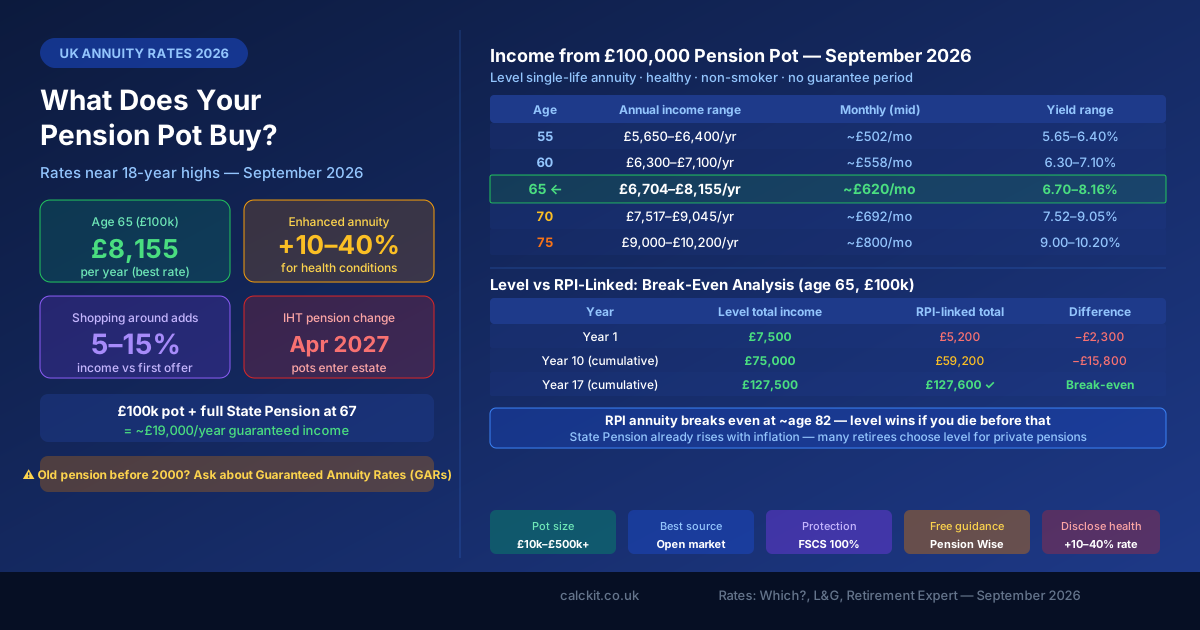
UK annuity rates reached a 14-year high in late 2022 and, against most expectations, they have stayed elevated ever since. As of September 2026, a healthy 65-year-old with a £100,000 pension pot can lock in up to £8,155 per year for life — that is £679 per month, guaranteed, regardless of what stock markets do.
That is a very different picture from 2021, when the same £100,000 would have bought roughly £4,500 per year. The shift matters because annuities offer something pension drawdown cannot: certainty. If you live to 90, the payments keep coming. If the stock market halves, the payments keep coming.
Before you decide whether to buy an annuity, you need to know three things: what your pot actually buys, whether you qualify for enhanced rates, and whether the guaranteed income plus your State Pension covers your retirement spending. This guide answers all three with specific numbers.
🏦Current UK Annuity Rates: September 2026
The tables below show indicative income from a £100,000 pension pot across different ages and annuity types. These are market rates as of September 2026 — actual quotes vary by provider and personal circumstances.
Level Single-Life Annuity (£100,000 pot)
| Age at purchase | Annual income range | Monthly income | Approx. yield |
|---|---|---|---|
| 55 | £5,650–£6,400 | £471–£533 | 5.65–6.40% |
| 60 | £6,300–£7,100 | £525–£592 | 6.30–7.10% |
| 65 | £6,704–£8,155 | £559–£679 | 6.70–8.16% |
| 70 | £7,517–£9,045 | £626–£754 | 7.52–9.05% |
| 75 | £9,000–£10,200 | £750–£850 | 9.00–10.20% |
Sources: Which? September 2026, Legal & General, Retirement Expert. Indicative market ranges — get a personal quote for exact figures.
Joint-Life (50% survivor) vs RPI-Linked (age 65, £100,000)
| Annuity type | Annual income | Monthly | Notes |
|---|---|---|---|
| Level single-life | £6,704–£8,155 | £559–£679 | Highest income; stops on death |
| Joint-life (50% to spouse) | £5,642–£7,744 | £470–£645 | Survivor gets 50% |
| Joint-life (67% to spouse) | £5,300–£7,200 | £442–£600 | More protection for spouse |
| RPI-linked (single) | £4,900–£5,500 | £408–£458 | Rises with inflation each year |
| Level + 10-year guarantee | £6,600–£7,900 | £550–£658 | Pays estate if you die within 10 yrs |
The spread within each row is the difference between shopping around (top end) and accepting the first offer (often bottom end). That spread on a standard £100k single-life annuity is over £1,400 per year — roughly £14,000 over 10 years.
Annuity Income by Pot Size (Age 65, Level Single-Life)
The table below shows what different pension pot sizes buy at age 65 in September 2026, with and without taking the 25% tax-free lump sum first.
| Pension pot | Income (no TFLS) | Income (25% TFLS taken) | TFLS cash |
|---|---|---|---|
| £50,000 | £3,352–£4,078/yr | £2,514–£3,058/yr | £12,500 lump sum |
| £100,000 | £6,704–£8,155/yr | £5,028–£6,116/yr | £25,000 lump sum |
| £150,000 | £10,056–£12,233/yr | £7,542–£9,175/yr | £37,500 lump sum |
| £250,000 | £16,760–£20,388/yr | £12,570–£15,291/yr | £62,500 lump sum |
| £500,000 | £33,520–£40,775/yr | £25,140–£30,581/yr | £125,000 lump sum |
Taking the tax-free lump sum reduces your annual income, but you receive 25% of your pot tax-free immediately. Whether this makes sense depends on your other income, inheritance wishes, and retirement spending plans.
What Drives UK Annuity Rates?
Annuity rates move primarily with 15-year gilt yields — the return the UK government pays on long-dated bonds. When gilt yields rise, insurers earn more on the bonds they hold to back annuity promises, so they can afford to pay higher rates.
This is why rates soared from 2021 to 2023 as the Bank of England raised interest rates rapidly, and why they have remained elevated into 2026 even as the base rate has moderated slightly. The underlying structure of gilt yields has stayed relatively high compared to the near-zero era of 2010–2021.
Other factors that affect your personal rate:
- Age: Every extra year raises your rate — a 70-year-old gets roughly 10–15% more than a 65-year-old on the same pot
- Health and lifestyle: Qualifying conditions can boost income by 10–40% (see enhanced annuities below)
- Annuity type: Level pays more upfront; inflation-linked pays less initially but rises over time
- Pot size: Larger pots often attract slightly better rates per £1,000 invested
- Guarantee period: A 5 or 10-year guarantee reduces income slightly but protects against dying early
- Provider: Rates differ by 10–20% between the best and worst providers for identical cases
Enhanced Annuities: The 10–40% Uplift Most People Miss
An enhanced (or impaired-life) annuity pays more because the insurer expects to pay for fewer years. If you have a condition that may reduce your life expectancy, you are almost certainly entitled to a higher rate — and many people never claim it.
Conditions that commonly qualify:
- Heart disease or history of heart attack
- Stroke or TIA
- Type 1 or Type 2 diabetes
- High blood pressure (even if well-controlled)
- Cancer (current or history)
- Obesity (BMI 30+)
- Smoking (current or within last 5 years)
- Chronic kidney disease
- COPD / severe asthma
The uplift is significant. On a £100,000 pot at age 65, a smoker with high blood pressure might receive £9,500–£10,500 per year compared to £7,000–£8,000 for a healthy non-smoker — an extra £1,500–£2,500 per year, potentially £30,000–£50,000 over a 20-year retirement.
Always disclose health conditions when getting annuity quotes. Failing to disclose does not invalidate your policy, but it means you leave money on the table. Providers cannot increase your rate after the annuity is set up. You only get one chance to disclose at the point of purchase.
Level vs Inflation-Linked: The Break-Even Maths
The choice between a level (fixed) and RPI-linked annuity is one of the most important decisions you make — and the maths is often misunderstood.
Example: 65-year-old with £100,000 pot
| Annuity type | Year 1 income | Year 10 income (est.) | Year 20 income (est.) |
|---|---|---|---|
| Level | £7,500/yr | £7,500/yr | £7,500/yr |
| RPI-linked (3% inflation) | £5,200/yr | £6,989/yr | £9,390/yr |
The RPI-linked annuity starts £2,300/year lower. It takes approximately 14–17 years to generate the same cumulative income as the level version — meaning you'd need to live past 79–82 for the RPI version to "win" in total income received.
When a level annuity makes sense:
- You have other income sources (State Pension, defined benefit pension) that already rise with inflation
- Your pot is smaller (£50,000–£100,000) and you need maximum income now
- You are in good health but not exceptional — you may not live long enough for RPI to pay off
- You expect to spend more in early retirement (travel, activities) than in your 80s
When an inflation-linked annuity makes sense:
- You are in excellent health and expect a long retirement
- Your level annuity income would cover only basic needs — any real-terms cut would cause hardship
- You have no other inflation-linked income and your State Pension is partial
Most financial advisers suggest that the State Pension itself provides a degree of inflation protection (through the triple lock) and that many retirees can reasonably choose a level annuity for a top-up pension.
Single vs Joint-Life: Protecting a Surviving Spouse
If you have a partner who depends on your pension income, a joint-life annuity pays a percentage (typically 50% or 67%) to your surviving spouse after you die.
The trade-off: a joint-life annuity pays less while you are both alive. On a £100,000 pot at age 65, switching from single-life to joint-life (50%) reduces income by roughly £700–£1,200 per year. Whether that reduction is worth it depends on:
- Whether your partner has their own pension income
- The age gap between you (a younger partner makes joint-life more valuable)
- Whether your partner would struggle financially if your income stopped
If you die without a joint-life option and have a surviving spouse who relied on your pension income, they receive nothing from your annuity. For couples where one partner has significantly less pension saving, joint-life protection is often worth the income reduction.
The Open Market Option: Why You Must Shop Around
Your pension provider is legally required to tell you about the Open Market Option (OMO) — your right to buy an annuity from any provider, not just the company holding your pension pot.
Research consistently shows that accepting your pension provider's default offer costs retirees money:
- Standard annuities: shopping around adds 5–15% income
- Enhanced annuities: the best provider can offer 15–20% more than the worst
On a £200,000 pot at 65, a 10% improvement is worth roughly £15,000 over 15 years.
How to exercise the OMO:
- Get quotes from at least three providers directly (L&G, Aviva, Canada Life, Scottish Widows, Standard Life, Just)
- Use a regulated annuity broker or comparison service — they search the whole market
- Book a free guidance appointment with Pension Wise (MoneyHelper, 0800 011 3797) before committing
- Consider an independent financial adviser for pots over £100,000 — their fee is typically recovered through better rates within 2–3 years
Advertisement
Annuity vs Pension Drawdown in 2026
Since the pension freedoms legislation in 2015, most people with defined contribution pensions can choose between an annuity and flexible drawdown. Neither is universally better.
| Factor | Annuity | Drawdown |
|---|---|---|
| Income certainty | Guaranteed for life | Variable — depends on investment returns |
| Investment risk | None — insurer bears it | You bear all investment risk |
| Flexibility | None — fixed at purchase | Full flexibility to adjust withdrawals |
| Inflation protection | Only if RPI option chosen | Investments may grow ahead of inflation |
| Longevity risk | Eliminated | Risk of running out of money in old age |
| Death benefits (before 75) | Reduced (guarantee period only) | Full pot passes to beneficiaries tax-free |
| Death benefits (from 2027) | N/A — annuity income stops | Pension pot enters estate for IHT (see below) |
| Complexity | Simple — set and forget | Requires ongoing management |
| Minimum viable pot | ~£10,000 | Typically better above £50,000 |
For a pension pot of £50,000–£150,000, annuities often make more practical sense — the income is meaningful, the simplicity is valuable, and the longevity risk protection is significant. For pots above £300,000, many advisers recommend a blend.
🐷The IHT 2027 Angle: Why Annuities Are More Attractive Now
From April 2027, unused pension pots will become subject to inheritance tax as part of the estate for most people. Currently, a pension pot left on death passes to beneficiaries free of IHT — a major advantage of drawdown over annuities for estate planning.
That advantage disappears from 2027. Once a pension pot is brought into the estate:
- It will be subject to 40% IHT above the nil-rate band (£325,000)
- Combined with income tax for the beneficiary, effective tax rates on inherited pension pots could exceed 60–70%
- The argument that "drawdown preserves the pot for my children" significantly weakens
This does not mean everyone should rush to buy an annuity before April 2027. But it does mean the decision has changed. If you were keeping money in drawdown primarily for IHT reasons, revisit that calculation with a financial adviser. See our pension drawdown rules guide for the full drawdown picture.
State Pension + Annuity: Your Total Retirement Income
A common mistake is looking at annuity income in isolation. In practice, most retirees receive their State Pension plus any private pension income. Understanding the combined picture helps you decide how much annuity income you actually need.
Example: retiring at 67 with the full new State Pension (2026/27)
The full new State Pension in 2026/27 is approximately £11,500/year (see our State Pension 2026/27 guide for the exact figure). Combined with a pension pot:
| Pension pot | Annuity income | State Pension | Total/year | Total/month |
|---|---|---|---|---|
| £50,000 | £3,750 | £11,500 | £15,250 | £1,271 |
| £100,000 | £7,500 | £11,500 | £19,000 | £1,583 |
| £150,000 | £11,250 | £11,500 | £22,750 | £1,896 |
| £250,000 | £18,750 | £11,500 | £30,250 | £2,521 |
| £500,000 | £37,500 | £11,500 | £49,000 | £4,083 |
Annuity rates assumed at 7.5% for illustration. State Pension figure approximate for 2026/27.
The Trades Union Congress (TUC) and Pensions and Lifetime Savings Association (PLSA) estimate a comfortable retirement for a single person requires roughly £23,000–£31,000/year. That means a £150,000–£250,000 pension pot — combined with the full State Pension — broadly covers a comfortable retirement on an annuity basis, with no investment management required.
What Is a Guaranteed Annuity Rate (GAR)?
Some older pension policies (especially those taken out in the 1970s–1990s) include a Guaranteed Annuity Rate (GAR) — a contractually fixed rate at which the provider must offer you an annuity, regardless of market conditions.
GARs from those decades are typically in the range of 9–12%, compared to current market rates of 7–8%. If your pension has a GAR:
- It is almost certainly worth activating, even if market rates look attractive
- Check your pension's terms — the GAR may only apply if you retire at the original contract age (often 60 or 65)
- The GAR may only apply if you take the annuity from the original provider (do not transfer away without professional advice)
- The value of a GAR on a £100,000 pot at 10% versus a market rate of 7.5% is an extra £2,500 per year for life
If you have an old workplace or personal pension from before 2000, ask your provider explicitly: "Does this policy contain a guaranteed annuity rate?" Many providers do not proactively flag this. A GAR can be worth tens of thousands of pounds over a retirement.
Phased Annuity Purchasing
Instead of converting your entire pension pot at once, you can buy annuities in stages — a strategy called phased purchasing or vesting in tranches.
Why this works:
- Each tranche you buy reflects the rate available at that time — you are not "all in" at one moment
- Rates tend to be higher as you age, so buying later typically means more income per pound
- You retain flexibility in drawdown with the remaining pot
Example: Retirement at 65 with £300,000 pot.
- Year 1 (age 65): Buy £100,000 annuity at 7.5% = £7,500/year guaranteed
- Year 3 (age 67): Buy another £100,000 at (estimated) 8.2% = £8,200/year
- Year 7 (age 72): Buy final £100,000 at (estimated) 9.5% = £9,500/year
- Total by 72: £25,200/year — substantially more than buying all three at once at 65 (£22,500/year)
The risk is that rates fall before you buy each subsequent tranche. A qualified financial adviser can model the break-even scenarios for your specific situation.
FSCS Protection: What Happens If Your Provider Fails?
Annuity providers in the UK are regulated by the FCA and PRA. If your annuity provider becomes insolvent, the Financial Services Compensation Scheme (FSCS) protects:
- 100% of annuity income with no upper limit for annuities in payment
- This is different from the £85,000 savings protection for bank deposits
An annuity in payment is treated as a "long-term insurance contract" — FSCS covers it fully. This makes annuities one of the most robustly protected retirement income products available.
Is an Annuity Worth It in 2026? The Honest Verdict
Buy an annuity if:
- You want guaranteed income and find investment uncertainty stressful
- Your pension pot is modest (under £150,000) and drawdown wouldn't generate enough reliable income
- You have health conditions that would boost your rate by 15%+
- You have a GARs on your policy — almost always use it
- You don't have significant other savings to fall back on
- You value simplicity and do not want to manage investments in retirement
Consider drawdown instead if:
- Your pot is large (£300,000+) and you can afford to take investment risk
- You have other guaranteed income (defined benefit pension, rental income) that covers your basic needs
- You want maximum flexibility to leave money to family
- You are in excellent health and comfortable with longevity risk
The middle path: Use your pension pot to buy a modest annuity that — combined with your State Pension — covers your essential spending (rent/mortgage, bills, food). Use any remaining pot or other savings for discretionary spending. This gives you a guaranteed income floor without locking up all your flexibility. See our how much do I need to retire guide to work out your own floor.
Key Steps Before You Buy
- Get a pension valuation — confirm the current value and whether any GAR exists
- Book Pension Wise — free impartial guidance service (0800 011 3797 or moneyhelper.org.uk)
- Get at least 3–5 market quotes — never accept the first offer from your existing provider
- Disclose all health conditions — even well-controlled ones; let the provider decide eligibility
- Decide on options: single/joint, level/RPI, guarantee period before comparing quotes
- Consider regulated financial advice for pots over £100,000 — the cost is typically recovered in 2–3 years through better rates
- Do not rush — take the time to compare; once set, an annuity cannot be changed
Last updated September 2026. Annuity rate data from Which?, Legal & General, and Retirement Expert (September 2026). IHT pension changes from HM Treasury Budget 2024 announcement (effective April 2027). For personalised advice on retirement income, consult a qualified independent financial adviser regulated by the FCA.