
Average UK rents hit a record high in 2025 and have barely retreated since. For homeowners with a spare bedroom, renting it out to a lodger can generate £500–£700 per month — roughly £6,000–£8,400 per year — and much of that can be completely tax-free.
The Rent a Room Scheme has been around since 1992 and is genuinely one of the most straightforward tax reliefs available. Earn under the limit, report nothing to HMRC, pay no tax. But three traps catch homeowners by surprise: the joint-owner rule that halves your allowance, the combined-income trap when you have two lodgers, and the mortgage permission requirement that most people skip.
This guide covers the 2026/27 rules in full, with worked examples for every scenario.
🏛What Is the Rent a Room Scheme?
The Rent a Room Scheme is a UK government tax exemption that allows you to receive up to £7,500 per year in gross rental income from a furnished room in your main home — completely free of income tax.
It applies whether you are an owner-occupier or a tenant (as long as your lease permits sub-letting). It covers any arrangement where you let a furnished room and continue living in the property alongside the lodger.
The exemption is automatic. You do not need to register, apply, or even tell HMRC — provided your total gross receipts from the room stay within the £7,500 threshold for the tax year (6 April to 5 April).
Who Qualifies?
You must meet all three of these conditions:
- Main residence: The property must be your only or main home — not a buy-to-let or second property
- Furnished accommodation: The room you let must be furnished (a bare room does not qualify)
- You live there: You must be resident in the property — the lodger lives with you, not instead of you
You do not qualify if:
- The lodger has a self-contained flat or annexe with their own entrance, kitchen, and bathroom (a licensee, not a lodger)
- You let the whole property and move out while they are there
- The property is a company let
- You own the property as an investment and do not live there
The key distinction: a lodger is a licensee — they rent a room in your home and share spaces like the kitchen and bathroom. They have no security of tenure. This is different from a tenant, who has exclusive possession of a property or unit and full tenancy rights.
What Counts Toward the £7,500?
The £7,500 is measured on gross receipts — everything your lodger pays you before any expenses are deducted:
- Base rent (the core weekly or monthly charge)
- Bills and utilities you recharge (electricity, broadband, council tax contributions)
- Meals, if you provide them
- Cleaning or laundry services
- Any other service charges
What does not count:
- Security deposits (these are not income until you retain them)
- Payments for damage or breakage (reimbursement, not income)
Example: Your lodger pays £550/month in rent plus £75/month toward bills = £625/month total. Annual gross receipts = £7,500 — exactly at the limit. No tax to pay.
If they pay £650/month all-in = £7,800/year. You are £300 over the threshold and need to choose Method A or Method B.
The Joint-Owner Trap
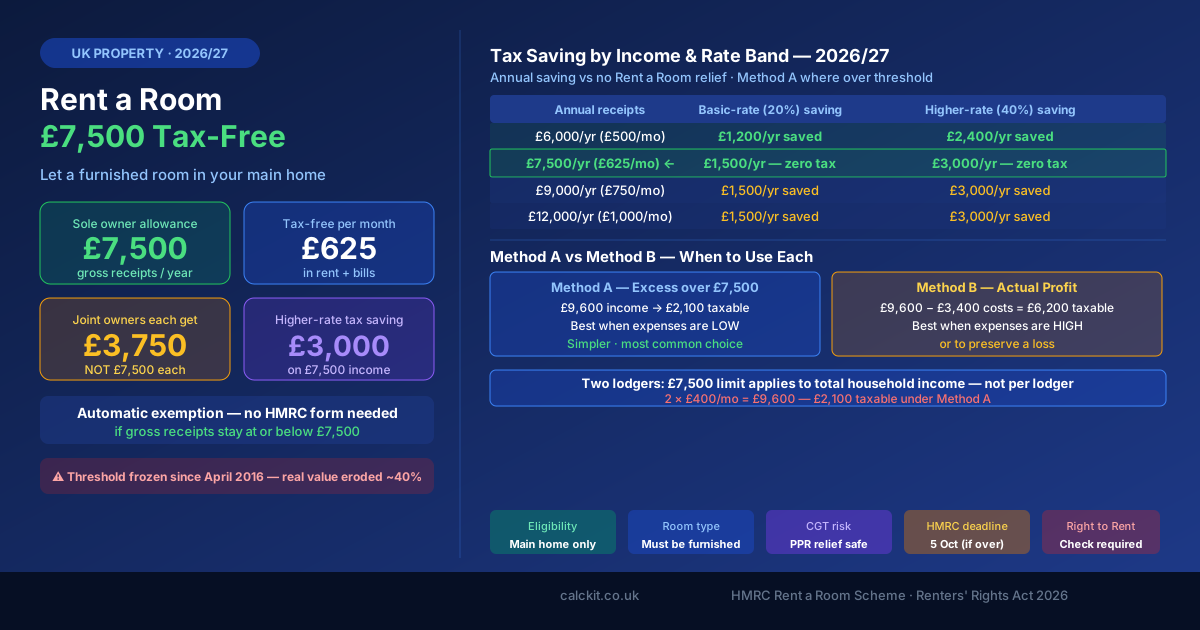
If two people share the rental income from a lodger — typically a couple who jointly own or rent the property — the £7,500 limit is split between them. Each person gets a £3,750 allowance, not £7,500.
| Scenario | Total receipts | Each person's income | Allowance each | Taxable each |
|---|---|---|---|---|
| Sole owner | £7,500 | £7,500 | £7,500 | £0 |
| Sole owner | £9,000 | £9,000 | £7,500 | £1,500 |
| Joint owners | £7,500 | £3,750 | £3,750 | £0 |
| Joint owners | £8,400 | £4,200 | £3,750 | £450 each |
| Joint owners | £10,000 | £5,000 | £3,750 | £1,250 each |
A couple taking in a lodger at £700/month (£8,400/year) are both paying tax on £450 each — even though the total household income is still under the £7,500 sole-owner threshold. Many couples do not realise this until their self-assessment return is due.
The Two-Lodger Trap
The £7,500 limit is per household, not per lodger. If you take in two lodgers, both lots of income count toward the same single allowance.
Example: You have two lodgers, each paying £400/month.
- Total gross receipts: £9,600/year
- Rent a Room allowance: £7,500
- Taxable income under Method A: £2,100
At a 20% basic rate, that is £420 in tax per year. At 40% higher rate, it is £840.
Many homeowners taking in a second lodger assume their £7,500 allowance doubles. It does not.
What Happens When You Exceed £7,500
Once your gross receipts exceed £7,500 (or £3,750 for joint owners), you have two options for calculating your taxable income. You choose which to use each tax year.
Method A — Excess Above the Threshold
Tax only the amount over the £7,500 threshold.
Example: Gross receipts £9,600, no significant expenses.
- Taxable income: £9,600 − £7,500 = £2,100
- Tax at 20%: £420
Method B — Actual Profit (Normal Property Income Basis)
Ignore the Rent a Room threshold entirely. Tax your actual profit: gross receipts minus allowable expenses.
Allowable expenses under Method B include:
- Proportion of mortgage interest on the room (at basic rate only, post-Section 24)
- Proportion of insurance, council tax, utilities, broadband
- Repairs and maintenance to the lodger's room
- Wear and tear or replacement furniture
- Letting agent fees
Same example with £3,400 of allowable expenses:
- Profit: £9,600 − £3,400 = £6,200
- Tax at 20%: £1,240
In this case, Method A (tax on £2,100) is far better than Method B (tax on £6,200). But if your expenses were £8,000 — perhaps because you spent heavily on renovations — Method B produces a taxable profit of £1,600, lower than Method A's £2,100.
Which Method Should You Choose?
| Your expenses vs the excess | Better method |
|---|---|
| Expenses are low (under £2,000) | Method A — simpler, lower tax |
| Expenses roughly equal the excess | Either — check both |
| Expenses exceed the excess | Method B — shows lower profit |
| You have a loss | Method B — only method that preserves losses |
You can switch between Method A and Method B from year to year. However, you must opt out of Method A by the self-assessment filing deadline (31 January following the tax year end). If you file using Method A one year, you can switch to Method B the next year — and vice versa.
Tax Saving by Marginal Rate (2026/27)
The table below shows how much tax the Rent a Room Scheme saves compared to treating lodger income as normal property income with no allowable expenses.
| Annual receipts | Taxpayer rate | Without scheme | With scheme (Method A) | Annual saving |
|---|---|---|---|---|
| £6,000 | 20% basic | £1,200 | £0 | £1,200 |
| £6,000 | 40% higher | £2,400 | £0 | £2,400 |
| £7,500 | 20% basic | £1,500 | £0 | £1,500 |
| £7,500 | 40% higher | £3,000 | £0 | £3,000 |
| £9,000 | 20% basic | £1,800 | £300 | £1,500 |
| £9,000 | 40% higher | £3,600 | £600 | £3,000 |
| £12,000 | 20% basic | £2,400 | £900 | £1,500 |
| £12,000 | 40% higher | £4,800 | £1,800 | £3,000 |
"Without scheme" assumes no allowable expenses (gross = taxable). With scheme uses Method A. Higher-rate taxpayers benefit more in absolute terms.
Higher-rate taxpayers benefit most from the Rent a Room Scheme. A homeowner paying 40% tax and taking in a lodger at £625/month (£7,500/year) keeps the full £3,000 they would otherwise pay in income tax.
Do You Need to Tell HMRC?
Under £7,500 — automatic exemption
If your gross receipts are £7,500 or less, you do not need to do anything. You do not need to:
- Register for self-assessment
- Complete a tax return
- Notify HMRC
The exemption is automatic. The only exception: if you are already required to complete a self-assessment return for other reasons (e.g. self-employment income, capital gains), you should declare the income on the SA105 property pages and claim the Rent a Room exemption.
Over £7,500 — you must register
If you exceed the threshold, you must register for self-assessment by 5 October following the end of the tax year in which you exceeded it.
For the 2026/27 tax year (ending 5 April 2027), the deadline to register is 5 October 2027. Your tax return and any tax owed is due by 31 January 2028.
You then choose Method A (excess) or Method B (profit) when completing your SA105 property income pages.
The £1,000 Property Allowance: Which Is Better?
The UK government also offers a separate £1,000 property allowance — you can earn up to £1,000 in property income per year with no tax liability. This is different from the Rent a Room allowance.
You cannot combine both allowances on the same income. You must choose one or the other for lodger income:
| Scenario | Rent a Room (£7,500) | Property allowance (£1,000) | Better choice |
|---|---|---|---|
| Annual receipts £800 | £0 tax | £0 tax | Either (same result) |
| Annual receipts £5,000 | £0 tax | £4,000 taxable | Rent a Room |
| Annual receipts £7,500 | £0 tax | £6,500 taxable | Rent a Room |
| Annual receipts £9,000 | £1,500 taxable (Method A) | £8,000 taxable | Rent a Room |
The Rent a Room allowance is almost always better for live-in landlords unless your total lodger income is under £1,000 (in which case both exempt you entirely).
Making Tax Digital: What Live-In Landlords Need to Know
Making Tax Digital for Income Tax Self-Assessment (MTD ITSA) is being rolled out in stages. It requires eligible taxpayers to use compliant software to report income quarterly to HMRC, replacing the annual self-assessment return.
The rollout timeline:
- April 2026 (now active): Applies to individuals with combined self-employment and property income over £50,000
- April 2027: Threshold drops to £30,000
- April 2028: Expected to drop to £20,000 (consult HMRC for confirmed dates)
For most people taking in a single lodger, this threshold will not be reached purely from rental income. However, if you are self-employed or have other property income that pushes your combined total above the threshold, your lodger income must be reported through MTD-compliant software from the relevant date.
If your lodger income stays under £7,500 and you have no other reason to file self-assessment, MTD does not apply — the automatic exemption means you have no reportable property income. MTD only kicks in when you must file.
Benefits Interaction
Taking in a lodger can affect means-tested benefits. The key rules for 2026/27:
Universal Credit: Income from a lodger under the Rent a Room exemption (up to £7,500) is generally disregarded for Universal Credit purposes. Income above £7,500 may be taken into account as property income.
Housing Benefit (legacy): Similar disregard rules apply — check with your local authority.
Council Tax: Taking in a lodger means you are no longer living alone. You lose the 25% single-person discount on council tax. At average UK council tax rates, this costs roughly £400–£600 per year.
Pension Credit: Rental income may be taken into account — seek advice from Citizens Advice before taking in a lodger if you receive Pension Credit.
Child Benefit / High Income Child Benefit Charge: Rent a Room income above £7,500 becomes property income that could affect your adjusted net income. For those near the £60,000–£80,000 threshold, this is worth monitoring.
🐷The PPR Relief Risk: CGT When You Sell
One concern that stops some homeowners taking in a lodger: will renting a room affect their Capital Gains Tax position when they sell?
The good news: in most cases, no. Principal Private Residence (PPR) relief exempts gains on your main home from CGT. The Rent a Room Scheme is specifically designed to be compatible with PPR relief — renting a furnished room that you continue to share does not affect it.
The exception: If part of your home is used exclusively for business purposes — not shared with you — that portion may be treated as a business asset rather than a residential one. This could reduce PPR relief by the percentage of floor space exclusively used commercially.
For a standard lodger arrangement where the lodger has their own bedroom but shares the kitchen, bathroom, and living areas with you, PPR relief is unaffected. The lodger's bedroom is considered part of your main home because it is not exclusively theirs — you could use it yourself when the lodger is away, moves out, or the arrangement ends.
The CGT risk arises mainly for live-in landlords running something closer to a commercial bed-and-breakfast operation, not standard lodger arrangements.
Mortgage Permission and Insurance
Mortgage permission
Most standard residential mortgages include a condition that you must live in the property as your main home and may not sub-let without lender consent. Taking in a lodger technically falls within "sub-letting" in most lenders' terms.
In practice, most lenders will consent to a single lodger in your main home relatively easily — but you should ask before your lodger moves in, not after. Breaching mortgage conditions can technically trigger a demand for early repayment.
See our rent affordability guide for a broader look at how housing costs affect income.
Insurance
Standard home insurance typically covers the building and your possessions — but lodger arrangements introduce complications:
- Contents insurance may not cover a lodger's possessions (they need their own renters' insurance)
- Your insurer needs to know you have a lodger — failing to disclose is grounds to invalidate a claim
- Some policies require a specific "resident landlord" or "lodger" endorsement
- If your lodger causes damage, whether your insurer recovers costs depends on your policy terms
Notify your insurer before the lodger moves in. Many policies simply require a phone call; some add a modest premium surcharge.
Renters' Rights Act 2026: How It Affects Lodgers
The Renters' Rights Act received Royal Assent in May 2026, significantly changing tenancy rights in England. However, its impact on lodger arrangements is limited.
Lodgers are licensees, not tenants. Because a lodger does not have exclusive possession of any part of the property, the Act's core provisions — abolishing fixed-term tenancies, Section 21 notices, the Decent Homes Standard for the private rented sector — do not apply to them.
What does apply:
- Right to Rent checks: You must still verify that your lodger has the legal right to rent in England (Biometric Residence Permit, British/Irish passport, or share code)
- Harassment and unlawful eviction protections: These apply to lodgers under the Protection from Eviction Act 1977 — you must give reasonable notice to leave (typically 4 weeks by convention) even without a written agreement
The Renters' Rights Act tightened Right to Rent enforcement. Penalties for landlords (including resident landlords) who fail to carry out checks are now up to £5,000 per lodger for a first offence and £10,000 for repeat breaches.
Is £7,500 Enough in 2026?
The Rent a Room threshold has been frozen at £7,500 since 6 April 2016. Over that decade, UK consumer prices have risen roughly 40%. In 2016 purchasing power terms, £7,500 today is worth around £5,300.
Meanwhile, average UK rents have risen sharply — particularly in cities. A room in London now commonly rents for £900–£1,400/month. A homeowner in London taking a modest room price of £800/month earns £9,600/year, already £2,100 over the tax-free threshold.
The practical consequence: the scheme is less generous than it appears. For London and many major cities, the threshold does not cover a market-rate room, and most homeowners with lodgers will find themselves over the £7,500 limit.
The March 2024 Budget did not increase the threshold. There has been no government announcement of an upcoming increase. If you are in this situation, Method A (taxing only the excess) keeps the tax bill manageable — but it is worth running the numbers rather than assuming the scheme removes all tax liability.
Practical Checklist Before Taking in a Lodger
Before your lodger moves in:
- Check your mortgage terms and get lender consent in writing
- Notify your home insurer and add a lodger/resident landlord endorsement
- Carry out a Right to Rent check (keep a copy of the document you checked)
- Draw up a simple Licence Agreement (not an Assured Shorthold Tenancy)
- Agree notice periods for ending the arrangement (4 weeks is standard)
- Take a security deposit (protected schemes do not apply to lodgers, but a written receipt is good practice)
- Check your council tax position — notify the council you are no longer living alone
Tax planning:
- Check whether your gross annual receipts will stay under £7,500 (or £3,750 if joint)
- If you have or plan two lodgers, calculate the combined annual income
- If over the threshold, decide Method A vs Method B before filing
- If self-employed with other income, check your combined total against the MTD ITSA thresholds
See our income tax calculator to check how lodger income would affect your total tax position.
Key Rules: Quick Reference
| Rule | 2026/27 figure |
|---|---|
| Tax-free threshold (sole owner) | £7,500 gross receipts |
| Tax-free threshold (joint owners) | £3,750 each |
| Method A taxable amount | Receipts minus £7,500 |
| HMRC registration deadline | 5 Oct after tax year end |
| Self-assessment filing deadline | 31 Jan after tax year end |
| MTD ITSA (combined income >£50k) | Active from April 2026 |
| MTD ITSA (combined income >£30k) | Active from April 2027 |
| Right to Rent penalty (first offence) | Up to £5,000 per lodger |
| Council tax single-person discount lost | 25% of annual bill |
Last updated September 2026. Rent a Room Scheme figures from HMRC (gov.uk/rent-room-in-your-home). MTD ITSA thresholds from HMRC Making Tax Digital guidance. Renters' Rights Act provisions effective May 2026. For personal tax advice, consult a qualified accountant or tax adviser.