
Most UK ecommerce sellers know their product cost. Fewer know their true cost — the number that includes platform fees, payment processing, shipping, packaging, and a reserve for returns. The gap between product cost and true cost is where ecommerce businesses silently lose money, often for months before they realise it.
This guide walks through how to build a complete cost stack, calculate a price floor, and set selling prices that account for every fee your chosen platform charges — with worked examples in GBP for the four main UK ecommerce platforms.
🛒The six cost layers of ecommerce pricing
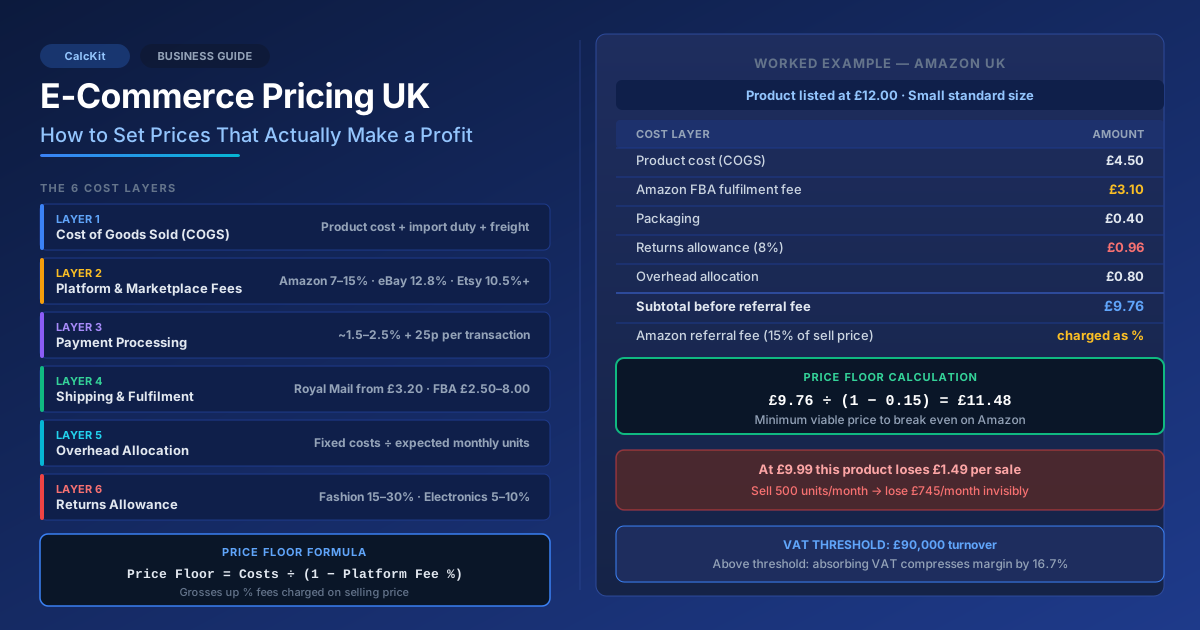
Before you can set a price, you need a number that represents what each unit actually costs you to sell. This is not your product cost — it's your product cost plus five additional layers that most sellers undercount.
Layer 1 — Cost of goods sold (COGS) What you paid for the product: manufacturing cost, wholesale price, or materials if you make it yourself. For imported goods, include import duty and freight. This is the only layer most sellers get right.
Layer 2 — Platform and marketplace fees Every platform takes a cut. Shopify charges card processing fees. Amazon takes a referral fee. eBay takes a final value fee. These fees are charged as a percentage of the sale price, which means they scale with price — and they're often higher than sellers expect. (Full breakdown by platform below.)
Layer 3 — Payment processing fees Even on your own website, every card payment incurs a processing fee — typically 1.4–2.5% of the transaction plus a fixed amount per transaction (e.g. 25p). On a £20 product sold 500 times a month, payment fees alone can cost £200–300 monthly.
Layer 4 — Shipping and fulfilment The cost to get the product to the customer. Include packaging materials, postage or courier cost, and any fulfilment centre fees. Royal Mail second class for a small parcel (up to 2kg) starts at approximately £3.20; couriers like Evri or DPD typically start at £2.80–3.50 for small parcels. Returns postage is a separate cost (Layer 6).
Layer 5 — Overhead allocation A share of fixed costs per unit: website hosting, subscriptions, storage, photography, insurance, accountancy. Divide your monthly overheads by the number of units you expect to sell to get a per-unit overhead figure. Many sellers treat overheads as invisible — they're not.
Layer 6 — Returns allowance Returns are a cost, not an anomaly. UK online retail return rates average 15–30% for clothing and accessories, 5–10% for electronics, and 3–8% for home goods. If 10% of your orders are returned, that's a return shipping cost plus re-inspection and restocking time you need to bake into every unit price, not absorb as a surprise when it happens.
The price floor formula
Your price floor is the minimum price at which you break even — zero profit, zero loss. It is not your target price. It is the absolute lower bound below which you lose money on every sale.
Price Floor = (COGS + Shipping + Packaging + Returns Allowance + Overhead per Unit) ÷ (1 − Platform Fee %)
Because platform fees are charged as a percentage of the selling price (not your cost), you need to gross them up rather than simply add them. Dividing by (1 − fee %) corrects for this.
Worked example — selling a £12 product on Amazon UK:
| Cost Layer | Amount |
|---|---|
| Product cost (COGS) | £4.50 |
| Amazon FBA fulfilment fee (small standard) | £3.10 |
| Packaging | £0.40 |
| Returns allowance (8% of expected selling price) | £0.96 |
| Overhead allocation | £0.80 |
| Subtotal before referral fee | £9.76 |
| Amazon referral fee (15% of selling price) | Charged as % |
Price floor = £9.76 ÷ (1 − 0.15) = £11.48
At £12, this product makes approximately £0.52 per sale. At the instinctive round-number price of £9.99, it loses £1.49 on every unit — and the business is eroding its working capital invisibly.
The price floor is not your target price — it's a sanity check. Your actual selling price should sit far enough above the floor to generate the margin you need. If your target is 30% net margin, your selling price needs to be £9.76 ÷ (1 − 0.30 − 0.15) = approximately £17.75 on this product.
Setting your target selling price
Once you know your floor, set your price based on a target margin.
Selling Price = (COGS + Fixed Costs Per Unit) ÷ (1 − Target Margin % − Platform Fee %)
What margin should you target?
| Product Type | Typical Gross Margin Target |
|---|---|
| Fashion and clothing | 50–65% |
| Handmade and craft goods | 60–80% |
| Health and beauty | 45–60% |
| Homeware and gifts | 40–55% |
| Electronics and tech | 15–25% |
| Books and media | 20–35% |
| Sports and outdoors | 35–50% |
| Food and consumables | 30–50% |
These are gross margin targets — revenue minus direct costs (COGS, shipping, platform fees) before overheads. Net margin after overheads and marketing will be lower, typically 10–25% for a healthy ecommerce business.
📈For the relationship between markup percentage and margin percentage — they're different numbers and confusing them is one of the most common pricing mistakes — see Markup vs Margin Explained.
Platform fees: UK breakdown
Fees vary meaningfully between platforms. Use these as inputs into your cost stack — the ecommerce profit calculator above runs the full calculation for each channel.
Shopify (direct-to-consumer)
Shopify's monthly plan costs (2026) determine your card processing rate:
| Plan | Monthly Cost | Shopify Payments Rate | Third-Party Payment Fee |
|---|---|---|---|
| Basic | £25 | 1.7% + 25p | 2% |
| Shopify | £65 | 1.6% + 25p | 1% |
| Advanced | £344 | 1.5% + 25p | 0.5% |
Using Shopify Payments eliminates the third-party transaction fee and is almost always worth it. On a £40 order at Basic plan: card processing ≈ £0.93 (1.7% + 25p). There are no per-sale referral fees beyond card processing — your only other variable cost is your COGS and shipping.
Shopify is typically the lowest-fee channel for direct sales, but you carry the traffic acquisition cost — there are no built-in customers, so you need to factor in marketing spend (typically 10–20% of revenue for paid acquisition) when modelling profitability.
Amazon UK
Amazon Professional seller account: £25/month ex-VAT.
Referral fees by category (% of sale price):
| Category | Referral Fee |
|---|---|
| Electronics | 7% |
| Computers | 7% |
| Clothing and accessories | 15% |
| Shoes and bags | 15% |
| Toys and games | 7–15% |
| Beauty and personal care | 8% |
| Books | 15.45% |
| Home and kitchen | 7–15% |
| Sports and outdoors | 10% |
| Grocery | 8% |
If you use FBA (Fulfilled by Amazon), add fulfilment fees per unit:
| Size Category | Weight | Approximate FBA Fee |
|---|---|---|
| Small envelope | Under 100g | £2.00–2.50 |
| Standard envelope | 100g–900g | £2.50–3.20 |
| Small oversize | 900g–2kg | £4.50–5.50 |
| Standard oversize | 2kg–5kg | £6.00–8.00 |
FBA also charges monthly storage fees (approximately £0.30–0.90 per cubic foot depending on season, with higher rates Oct–Dec). FBA's advantage is Prime eligibility, which typically lifts conversion rates by 15–30% — worth modelling as a revenue increase against the fee cost.
eBay UK
eBay charges a final value fee on the total amount the buyer pays (including postage):
- Most categories: 12.8% of the total transaction amount + 30p per order
- Motors: reduced rate (varies by listing type)
- Charity sellers: 0%
Business sellers get 200–400 free listings per month depending on store subscription; additional listings cost £0.30–0.35 each. Promoted listings are optional but effective — typically 2–5% of sale price, charged only when the promoted listing leads to a sale.
eBay example — £25 item with £3.50 postage:
- Final value fee: 12.8% × £28.50 = £3.65
- Per-order fee: £0.30
- Total eBay fees: £3.95 (14% of transaction)
Etsy UK
Etsy charges UK sellers three main fees:
- Listing fee: £0.18 per item (charged when listed, renewed every 4 months or on sale)
- Transaction fee: 6.5% of the total sale price including postage
- Payment processing (Etsy Payments): 4% + £0.20 per transaction
Etsy example — £35 item with £4 postage:
- Listing fee (amortised): £0.045 per sale (assuming 4 sales before renewal)
- Transaction fee: 6.5% × £39 = £2.54
- Payment processing: 4% × £39 + £0.20 = £1.76
- Total Etsy fees: £4.34 (11.1% of transaction)
Etsy also runs offsite ads — if you've made over £10,000 in sales on Etsy, participation is mandatory and costs 12% of sales attributed to Etsy's external advertising. Below £10,000 you can opt out.
VAT and pricing — the £90,000 threshold
If your VAT-taxable turnover exceeds £90,000 in any rolling 12-month period (current threshold from April 2024), you must register for VAT. This changes your pricing in one of two ways:
Option 1 — Add VAT to your prices. Your £30 product becomes £36 (£30 + £6 VAT). Customers pay more; your margin is unchanged. This works if your buyers are businesses who can reclaim the VAT — it has no real cost to them. For B2C (selling to consumers), a 20% price rise is a conversion risk.
Option 2 — Absorb VAT within your existing price. Your £30 product stays at £30, but £5 of that goes to HMRC (£30 ÷ 1.2 = £25 + £5 VAT). Your effective revenue per unit drops from £30 to £25 — a 16.7% margin compression. This protects conversion but hurts profitability.
Most B2C ecommerce businesses approaching the threshold need a hybrid approach: plan a price increase before registration to cushion the VAT impact. A 10% price rise (from £30 to £33) before registration, then absorbing VAT at registration (bringing effective revenue to £27.50 vs £30 previously) is a smaller shock than a sudden 20% jump.
Use the VAT calculator to model both scenarios:
%For detailed guidance on UK VAT rules, rates, and zero-rated goods, see How to Calculate VAT UK.
Markdown and discount pricing — the profit cost
Discounting is expensive. Because platform fees are charged on the original sale price, discounts come almost entirely out of your margin.
Worked example — 20% off a £25 product at 40% gross margin:
| Full Price | 20% Discount | |
|---|---|---|
| Sale price | £25.00 | £20.00 |
| Platform fee (12.8% + 30p) | £3.50 | £2.86 |
| Product cost | £8.00 | £8.00 |
| Shipping + packaging | £3.20 | £3.20 |
| Gross profit | £10.30 | £5.94 |
| Gross margin | 41.2% | 29.7% |
A 20% discount reduces gross profit per unit by 42% — not 20%. On volume sales during a promotion, this can turn a profitable product into a loss-maker. Before running any discount, calculate how many additional units you would need to sell at the discounted price to generate the same total profit as full price. The formula:
Units needed at discount = (Current profit per unit × Current volume) ÷ Discounted profit per unit
At full price selling 100 units/month: £10.30 × 100 = £1,030 profit. At 20% off: need £1,030 ÷ £5.94 = 174 units to break even on profit — a 74% volume increase just to stand still.
Common pricing mistakes that kill ecommerce margins
1. Calculating margin as markup. Adding 40% to a £10 product gives £14. That feels like a 40% margin — it's actually a 28.6% margin. The correct way: margin = profit ÷ selling price, not profit ÷ cost. See Markup vs Margin Explained for the full breakdown.
2. Ignoring platform fees when setting price, then accounting for them afterwards. Because platform fees are a percentage of the selling price, they need to be in the denominator of your calculation — not added on at the end. Adding 15% Amazon fee to a cost-derived price underestimates the actual fee.
3. Pricing across channels identically without accounting for fee differences. A price that works on Shopify (1.7% processing) does not automatically work on Amazon (15% referral + FBA fees). Each channel needs its own cost stack and price.
4. Not building returns into the base price. Returns are guaranteed at some rate. A 15% return rate with a £4 return shipping cost adds £0.60 to every unit's cost — whether you price for it or not.
5. Racing to the lowest price. Competing purely on price is a race your competitors can always join. A £1 lower price on Amazon is immediately visible; the result is margin compression across the category. Competing on product quality, listing quality, review count, and fulfilment speed is more durable.
Using the ecommerce profit calculator
The calculator below takes your product cost, selling price, and platform fee structure and outputs gross profit, margin, and break-even volume. Use it to check any price before listing.
🛒For the broader principles of pricing strategy — cost-plus vs value-based, psychological pricing, and when to raise prices — see How to Price Your Products.
For break-even analysis (how many units you need to sell to cover your fixed costs), see What is Break-Even Point?.
Frequently Asked Questions
Can I charge different prices on different platforms?
Yes — and you often should. Multi-channel repricing is standard practice. Your Shopify price (no referral fee, lower processing) will typically be lower than your Amazon price (15% referral fee) while delivering the same net margin. Some brands show a higher RRP on their own site and compete on price on Amazon; others reserve exclusive products or bundles for their own site to avoid direct price comparison.
How do I handle shipping costs — include them or charge separately?
"Free shipping" is a conversion driver on Amazon and eBay, where buyers filter by it. But free shipping is not actually free — it's built into your product price or absorbed from your margin. For the UK market, charging separately for shipping is standard for heavy or bulky items; for items under roughly 2kg, rolling shipping into the price and offering free delivery is typically better for conversion. Model both scenarios using the profit calculator.
What's a good break-even point for an ecommerce product?
There's no universal answer, but as a rule of thumb: if you can't break even at a volume you realistically expect to reach within 3 months, the unit economics probably don't work. Use the break-even calculator to model your fixed costs (platform subscription, advertising budget, overheads) against your margin per unit.
Should I use penetration pricing to launch a new product?
Penetration pricing (starting low to build volume and reviews) can work on Amazon where review count and sales velocity affect ranking. The risk is anchoring customers to a low price that's hard to raise later — price sensitivity research shows that even a 10–15% price increase after launch can significantly hurt conversion. If you use penetration pricing, plan your price increase timeline before launch and increase in small increments (5–8%) rather than one large jump.
Last updated July 2026. Platform fee figures are approximate and subject to change — always check the current fee schedules on Shopify, Amazon Seller Central, eBay Business Centre, and Etsy for sellers before pricing. VAT threshold £90,000 from April 2024 — verify the current threshold at gov.uk before making registration decisions.