
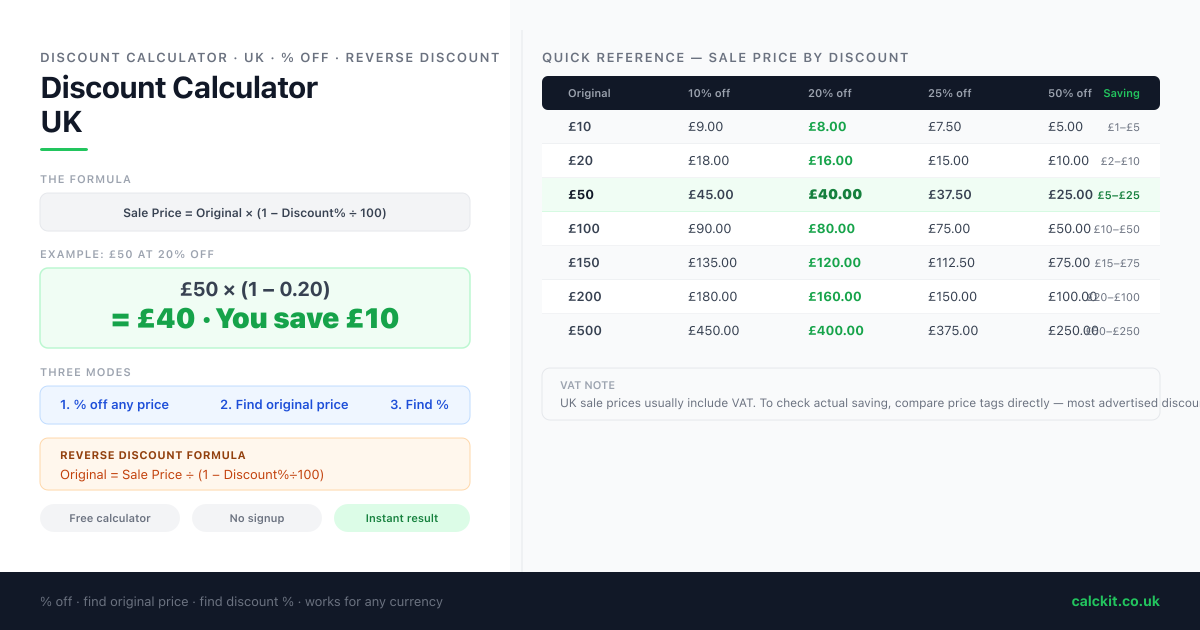
A 20% discount on £50 brings the price to £40 and saves you £10. Whether you are checking a sale price, finding what an item cost before a discount, or working out what percentage has been taken off, the maths comes down to one formula.
🏷The discount formula
The core calculation for finding a sale price:
Sale Price = Original Price × (1 − Discount% ÷ 100)
Example: £50 at 20% off:
£50 × (1 − 20 ÷ 100) = £50 × 0.80 = £40
Saving = £50 − £40 = £10
You can simplify the multiplier for common discounts:
| Discount | Multiplier | Shortcut |
|---|---|---|
| 5% off | × 0.95 | — |
| 10% off | × 0.90 | Divide by 10, subtract |
| 15% off | × 0.85 | — |
| 20% off | × 0.80 | Divide by 5, subtract |
| 25% off | × 0.75 | Divide by 4, subtract |
| 30% off | × 0.70 | — |
| 33% off | × 0.667 | Roughly divide by 3 |
| 40% off | × 0.60 | — |
| 50% off | × 0.50 | Divide by 2 |
Quick-reference discount table
| Original | 10% off | 20% off | 25% off | 50% off |
|---|---|---|---|---|
| £10 | £9.00 | £8.00 | £7.50 | £5.00 |
| £20 | £18.00 | £16.00 | £15.00 | £10.00 |
| £25 | £22.50 | £20.00 | £18.75 | £12.50 |
| £30 | £27.00 | £24.00 | £22.50 | £15.00 |
| £40 | £36.00 | £32.00 | £30.00 | £20.00 |
| £50 | £45.00 | £40.00 | £37.50 | £25.00 |
| £75 | £67.50 | £60.00 | £56.25 | £37.50 |
| £100 | £90.00 | £80.00 | £75.00 | £50.00 |
| £150 | £135.00 | £120.00 | £112.50 | £75.00 |
| £200 | £180.00 | £160.00 | £150.00 | £100.00 |
| £250 | £225.00 | £200.00 | £187.50 | £125.00 |
| £500 | £450.00 | £400.00 | £375.00 | £250.00 |
How to find the original price before a discount
If you know the sale price and the percentage discount, you can work backwards to find what the item cost before the sale. This is called a reverse discount calculation.
Original Price = Sale Price ÷ (1 − Discount% ÷ 100)
Example: An item is £60 in a 25% off sale. What was the original price?
£60 ÷ (1 − 25 ÷ 100) = £60 ÷ 0.75 = £80
Common mistake: People often try to find the original price by adding the discount percentage back on. That gives the wrong answer. Adding 25% to £60 gives £75, not £80. You must divide by (1 − the discount), not multiply by (1 + the discount).
How to find what percentage discount was given
If you know both the original price and the sale price, you can calculate the percentage that was taken off.
Discount% = (Original − Sale Price) ÷ Original × 100
Example: A coat dropped from £120 to £84. What percentage was taken off?
(£120 − £84) ÷ £120 × 100 = £36 ÷ £120 × 100 = 30%
This is useful when a retailer shows only the sale price and original price without stating the percentage, or when comparing discounts across different retailers.
📈Discounts and VAT in the UK
In the UK, prices displayed to consumers must include VAT at the standard rate (20% for most goods). When a retailer advertises a percentage discount, that discount applies to the VAT-inclusive price.
Example: A TV originally priced at £480 (inc. VAT) at 25% off:
£480 × 0.75 = £360 (inc. VAT)
For business purchases where you reclaim VAT, apply the discount to the net (ex-VAT) price first:
Net price (ex-VAT): £480 ÷ 1.20 = £400
Discounted net: £400 × 0.75 = £300
VAT at 20%: £300 × 1.20 = £360
The final price is the same either way (25% off a VAT-inclusive price equals 25% off the net price, then VAT added back). But knowing the net calculation matters when you need to separate VAT for invoicing or accounting.
The VAT calculator handles these VAT splits if you need to separate the net and VAT amounts after discounting.
Stacked discounts
A stacked discount is two discounts applied one after the other — common in trade pricing (e.g. 20% trade discount, then 10% for paying early).
Two consecutive discounts are not simply added together. A 20% discount followed by a 10% discount is not 30% off.
Step 1: £100 × 0.80 = £80  (after 20% off)
Step 2: £80  × 0.90 = £72  (after 10% off)
The combined effect is £28 off £100 — a 28% discount, not 30%.
Formula for the equivalent single discount:
Combined = 1 − (1 − d1) × (1 − d2)
For 20% and 10%:
1 − (1 − 0.20) × (1 − 0.10) = 1 − 0.80 × 0.90 = 1 − 0.72 = 28%
Discount vs markdown vs margin
These three terms are related but measure different things:
| Term | What it measures | Formula |
|---|---|---|
| Discount | Reduction from the original price | (Original − Sale) ÷ Original × 100 |
| Markdown | Same as discount — typically used in retail for planned price reductions | Same formula |
| Margin | Profit as a percentage of the sale price | (Sale − Cost) ÷ Sale × 100 |
A 30% discount tells you how much the price was reduced. A 30% margin tells you how much profit is made on the sale price. For the same item, a large discount can still leave a healthy margin if the original markup was high enough.
The profit margin calculator and markup calculator handle the margin and markup side of pricing.
Frequently Asked Questions
What is £200 with 15% off?
£200 at 15% off is £170. Calculation: £200 × 0.85 = £170. Saving: £30.
What is £30 with 20% off?
£30 at 20% off is £24. Calculation: £30 × 0.80 = £24. Saving: £6.
Is a 50% discount the same as half price?
Yes. A 50% discount means you pay half the original price. £60 at 50% off = £30.
How do I calculate a discount mentally?
For round percentages, break it into parts you know. For 20% off: find 10% (move the decimal one place left) and double it. £75: 10% = £7.50, 20% = £15. Sale price = £75 − £15 = £60.
For 25% off: find 50% (halve the price), then halve again. £80: 50% = £40, 25% = £20. Sale price = £80 − £20 = £60.
Last updated November 2026. All calculations use standard percentage discount formulas. UK VAT at 20% standard rate.