
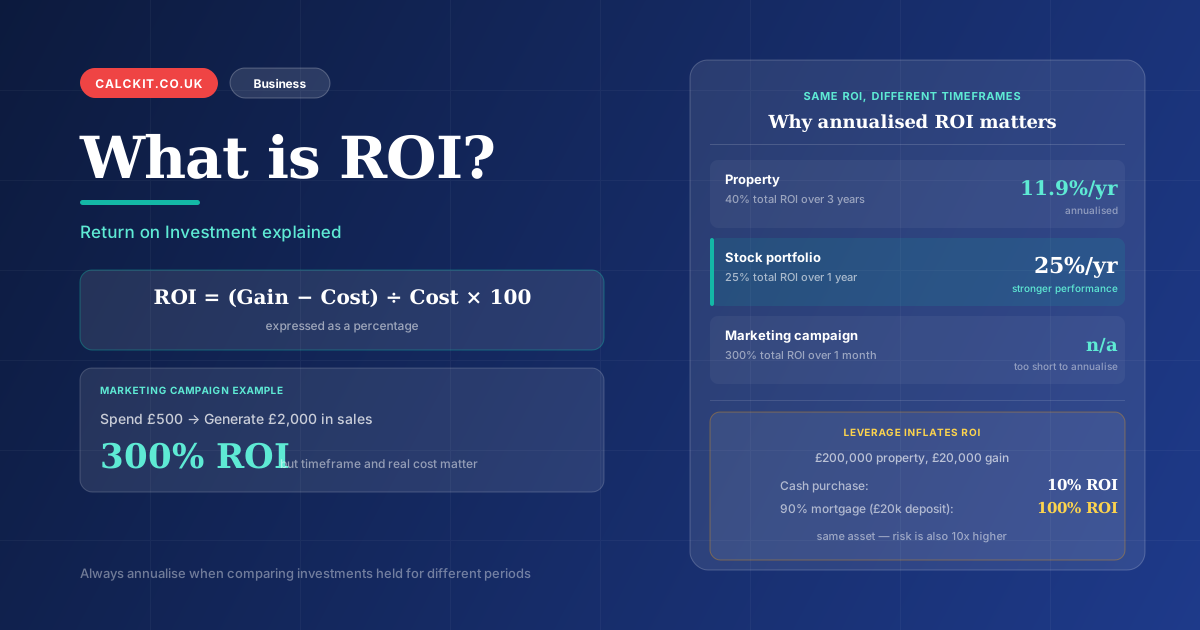
Spend £500 on a marketing campaign and generate £2,000 in sales, and your ROI is 300%. That sounds spectacular — but without knowing whether it took 3 weeks or 3 years, whether "sales" means revenue or actual profit after costs, the number tells you almost nothing on its own.
ROI is one of the most widely used — and most widely misused — metrics in business and investing. This guide covers the formula properly, worked examples in GBP for marketing, property, and small business investment, and the calculation mistakes that make ROI figures misleading if you don't account for them.
📊What is ROI?
Return on Investment (ROI) measures the profit or loss generated by an investment relative to its cost, expressed as a percentage. It can be applied to almost anything with a cost and a potential return: stocks, property, marketing campaigns, equipment purchases, training programmes, or a small business as a whole.
ROI = (Gain from Investment − Cost of Investment) ÷ Cost of Investment × 100
A positive ROI means the investment returned more than it cost. A negative ROI means a loss. An ROI of 0% means you broke even exactly.
Worked examples in GBP
Example 1 — Marketing campaign
You spend £500 on a social media advertising campaign. It generates £2,000 in sales.
| Step | Calculation | Amount |
|---|---|---|
| Gain | £2,000 | |
| Cost | £500 | |
| Gain − Cost | £2,000 − £500 | £1,500 |
| ROI | £1,500 ÷ £500 × 100 | 300% |
Important caveat: this assumes the full £2,000 is profit. If the products sold cost £800 to produce and deliver, your actual gain is £1,200 (£2,000 − £800), making the real ROI: (£1,200 − £500) ÷ £500 × 100 = 140% — still strong, but very different from the headline 300%.
Example 2 — Small business equipment
You spend £2,000 on a new piece of equipment that increases your business's annual profit by £5,000 over the following year.
| Step | Calculation | Amount |
|---|---|---|
| Gain | £5,000 | |
| Cost | £2,000 | |
| ROI | (£5,000 − £2,000) ÷ £2,000 × 100 | 150% |
Example 3 — Property investment
You buy a property for £250,000. Three years later, after selling, you've made £350,000 total (sale price plus any rental income, minus selling costs).
| Step | Calculation | Amount |
|---|---|---|
| Gain | £350,000 − £250,000 | £100,000 |
| ROI | £100,000 ÷ £250,000 × 100 | 40% |
This is the ROI over the full 3-year holding period — not per year. Comparing this fairly to other investments requires annualising it, covered next.
🛒Annualised ROI — why timeframe changes everything
A simple ROI figure says nothing about how long it took to achieve. A 40% ROI over 3 years is good. A 40% ROI over 3 months would be exceptional. Annualised ROI converts any return into an equivalent yearly rate so you can fairly compare investments held for different lengths of time.
Annualised ROI = [(Ending Value ÷ Beginning Value) ^ (1 ÷ Number of Years)] − 1
Worked example — the property from above (40% ROI over 3 years):
- Ending value ÷ Beginning value = £350,000 ÷ £250,000 = 1.4
- 1.4 ^ (1 ÷ 3) = 1.4^0.333 = 1.1187
- Annualised ROI = 1.1187 − 1 = 0.1187, or 11.87% per year
Why this matters when comparing investments:
| Investment | Total ROI | Holding period | Annualised ROI |
|---|---|---|---|
| Property | 40% | 3 years | 11.87% |
| Stock portfolio | 25% | 1 year | 25% |
| Marketing campaign | 300% | 1 month | (not meaningful to annualise — see below) |
The stock portfolio's 25% annual return is actually a stronger performance than the property's 40% total return, despite the smaller headline number — because it achieved nearly the same result in a third of the time.
Annualising very short-term ROI (weeks or a single month) produces extreme, often meaningless numbers — a 10% return in one month would "annualise" to over 200% per year, which misrepresents a one-off result as a sustainable repeatable rate. Annualised ROI is most useful for investments held one year or longer.
What is a "good" ROI? UK benchmarks by category
There is no universal good ROI — it depends entirely on the investment type, risk level, and timeframe.
| Investment type | Typical "good" benchmark | Notes |
|---|---|---|
| UK stock market (long-term) | 7–10% per year | Long-run FTSE All-Share and global index average, before inflation |
| Buy-to-let property | 5–8% annual yield + capital growth | See rental yield guide for the yield-specific calculation |
| Small business marketing | 200–500%+ per campaign | Highly variable by industry and channel; track over multiple campaigns, not one |
| Business equipment/software | 20–50%+ per year | Should clearly exceed your cost of capital or loan interest rate |
| Savings accounts | 3–5% per year | Lower risk, lower return — not a fair comparison to riskier categories |
The golden rule: never compare ROI figures across categories without adjusting for risk. A 300% ROI marketing campaign and a 7% ROI stock portfolio are not "the marketing campaign is 40x better" — they carry completely different levels of risk, repeatability, and scale.
ROI vs profit margin vs markup — clearing up the confusion
These three terms get used interchangeably, but they measure different things entirely:
| Metric | What it measures | Formula | Example |
|---|---|---|---|
| ROI | Return relative to what you spent on a specific investment | (Gain − Cost) ÷ Cost × 100 | Spend £500 on ads, make £2,000 → 300% ROI |
| Profit margin | Profit as a percentage of revenue from ongoing sales | (Revenue − Costs) ÷ Revenue × 100 | £100 sale, £75 cost → 25% margin |
| Markup | How much you add on top of cost to set a selling price | (Price − Cost) ÷ Cost × 100 | £75 cost, £100 price → 33% markup |
A business can run profitable day-to-day operations (healthy profit margin) while a specific investment — a new product line, a marketing channel, a piece of equipment — produces a poor ROI. These are separate questions: "is my business profitable overall?" (margin) vs "was this specific spend worth it?" (ROI). For the full breakdown of margin and markup specifically, see What is Profit Margin? and Markup vs Margin Explained.
£How leverage inflates ROI
Using borrowed money (leverage) to fund an investment can dramatically increase the ROI percentage, because the gain is calculated against your cash invested — not the full asset value.
Example: buying a £200,000 property
| Scenario | Cash invested | Gain (10% value increase = £20,000) | ROI |
|---|---|---|---|
| Cash purchase (no mortgage) | £200,000 | £20,000 | 10% |
| 80% mortgage (£40,000 deposit) | £40,000 | £20,000 | 50% |
| 90% mortgage (£20,000 deposit) | £20,000 | £20,000 | 100% |
The underlying asset performed identically in all three scenarios — only the ROI percentage changed, because leverage reduces the denominator (your actual cash cost) while the gain stays the same.
The catch: leverage cuts both ways. If the property value had fallen by 10% instead of rising, the cash-purchase scenario loses 10% of capital, but the 90%-mortgage scenario loses 100% of the deposit (and may owe more than the property is worth). A high leveraged ROI figure always implies higher risk — it should never be compared directly to an unleveraged ROI without acknowledging this.
ROI vs ROE — what's the difference?
ROI (Return on Investment) is a general-purpose metric usable for any investment — a campaign, an asset, a project, an entire business.
ROE (Return on Equity) is a specific corporate finance ratio: net income divided by shareholders' equity, used to assess how efficiently a company generates profit specifically from the equity invested by its owners/shareholders.
| ROI | ROE | |
|---|---|---|
| Used for | Any investment or project | Company-level financial analysis |
| Formula | (Gain − Cost) ÷ Cost | Net Income ÷ Shareholders' Equity |
| Typical user | Business owners, marketers, investors | Equity analysts, company shareholders |
If you are evaluating whether a marketing campaign or equipment purchase was worth it, you want ROI. If you are evaluating how efficiently a company as a whole uses shareholder capital, ROE is the more specific tool.
Common mistakes that make ROI figures misleading
1. Forgetting hidden costs. The "cost" in an ROI calculation should include everything — purchase price, fees, installation, training, financing costs, and your own time if it has a genuine opportunity cost. A campaign that "cost £500" in ad spend but took 20 hours of unpaid staff time to manage has a real cost well above £500.
2. Using revenue instead of profit as the "gain." As shown in the marketing example above, using gross sales rather than actual profit after costs of goods sold inflates ROI significantly. Always clarify whether your "gain" figure is revenue or net profit.
3. Ignoring the time period. A 50% ROI means nothing on its own — 50% over 6 months is excellent; 50% over 10 years is poor. Always state (or calculate) the holding period alongside the ROI percentage, and annualise when comparing investments of different durations.
4. Comparing different risk levels at face value. A higher ROI does not automatically mean a "better" investment if it came with significantly higher risk, less diversification, or required leverage. Risk-adjusted comparison matters more than the headline percentage.
5. Survivorship bias in examples. Marketing and business ROI "success stories" tend to highlight the campaigns or investments that worked. Track your own ROI across all activity — including the failures — for an honest picture of your actual average return.
Beyond ROI — NPV and payback period
ROI is simple and widely understood, but it has a structural limitation: it ignores when the money came back, beyond the basic timeframe adjustment of annualising. Two more sophisticated tools address this for bigger investment decisions:
Net Present Value (NPV) discounts future cash flows back to today's value, accounting for the fact that money received in 5 years is worth less than money received today (due to inflation and opportunity cost). NPV is the standard tool for comparing large capital investment decisions where cash flows arrive at different points over several years.
Payback period simply measures how long it takes to recover your initial investment cost from the gains, regardless of total ROI. A project with a faster payback period carries less risk, even if its eventual total ROI is lower than a slower-paying alternative.
For most day-to-day business decisions — was this campaign worth it, should I buy this equipment, is this investment performing — simple ROI (and annualised ROI for multi-year comparisons) is sufficient. NPV and payback period become more relevant for larger capital decisions spanning multiple years with uneven cash flows.
📊Frequently Asked Questions
Can ROI be negative?
Yes. A negative ROI means the investment generated less than it cost — for example, spending £1,000 on a campaign that only produced £700 in sales gives an ROI of (£700 − £1,000) ÷ £1,000 × 100 = −30%. Negative ROI is a clear signal to stop, adjust, or fully understand why before repeating the investment.
How is ROI different from break-even?
Break-even tells you the point at which total revenue equals total costs — neither profit nor loss. ROI tells you the percentage return once you're past that point (or how far below it you are, if negative). They're related concepts but answer different questions: break-even is a threshold; ROI is a performance measure. See What is Break-Even Point? for the full break-even formula and worked examples.
Should I use ROI to compare a marketing campaign and a stock investment?
Not directly. Different categories carry vastly different risk profiles, time horizons, and repeatability. A 300% marketing ROI from a single successful campaign is not equivalent to a 300% stock return — the marketing result may not repeat next month, while a diversified stock portfolio's long-run average is a much steadier, lower-risk figure. Use ROI to compare similar investments within the same category.
What counts as "cost" when calculating ROI for my time, not just money?
If you want to factor in your own time (common for freelancers and small business owners evaluating whether a project was worth it), assign yourself an hourly rate and add the total hours × rate to the cost side of the calculation. This often reveals that a project with a seemingly strong ROI on cash spent was actually only marginally profitable once unpaid time is properly costed in.
The bottom line
ROI is a simple, useful starting point for evaluating almost any investment — but the formula's simplicity is also its biggest risk. Always be clear about what counts as "gain" (revenue or profit?), what counts as "cost" (just the obvious spend, or all the hidden costs too?), and over what timeframe — then annualise when comparing investments of different lengths. Used carefully, ROI gives you a fast, comparable signal for whether something was worth doing again.
📊Last updated June 2026. This guide provides general information, not financial or investment advice — consult a qualified financial adviser before making investment decisions.