
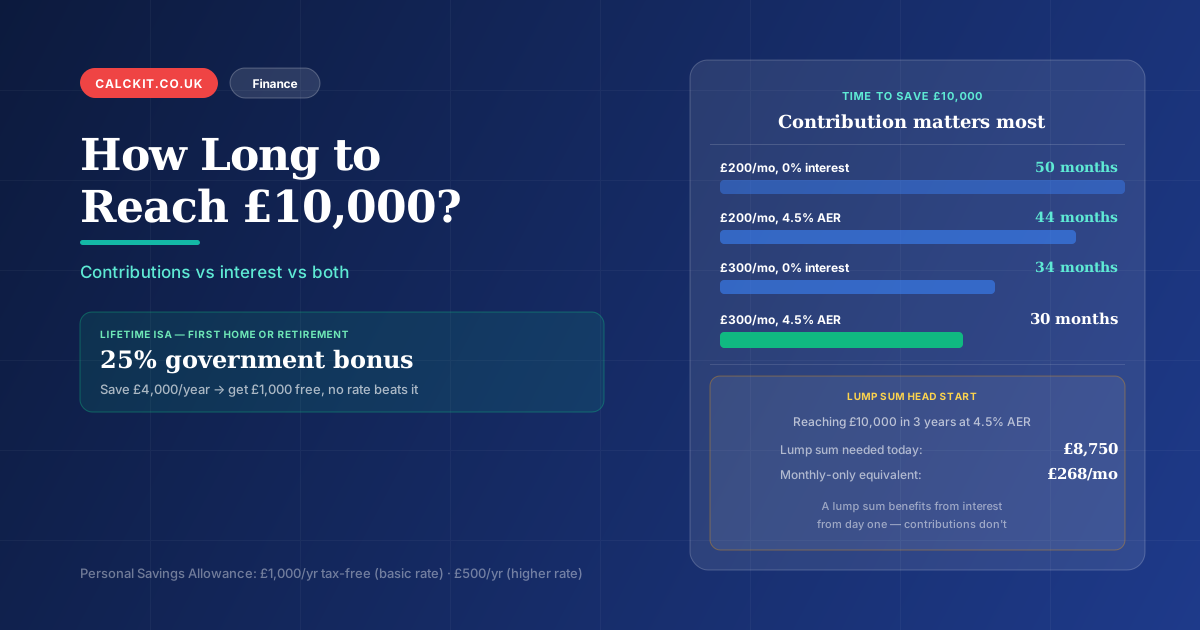
Saving £200 a month with no interest takes exactly 50 months to reach £10,000 — simple division. Add a 4.5% savings rate and the same goal is done in roughly 44 months. Increase the monthly amount to £300 instead, and you're there in about 30 months, even before counting interest.
Two levers determine how long it takes to reach a savings goal: how much you contribute, and what interest rate you earn. This guide breaks down exactly how each one moves your timeline, with worked UK examples, and covers where to actually put the money — including a government bonus most people researching savings goals have never heard of.
🐷What determines how long it takes to save?
Three factors determine your savings timeline:
- Your starting balance — money you already have saved
- Your regular contribution — how much you add each month
- Your interest rate (AER) — how much your balance grows on its own
A = P(1 + r/n)^(nt)
A = final amount, P = starting balance, r = annual interest rate, n = compounding periods per year, t = years
This is the standard compound interest formula used by every UK savings calculator — but it answers "how much will I have after X years?" The more useful question for a savings goal is the reverse: "how long until I reach £X?" Rearranging the formula for time requires logarithms, which is exactly why a calculator is faster than doing it by hand — but understanding the relationship between the three levers lets you make smart decisions without needing the maths.
🐷Worked example: saving £10,000
Scenario 1 — £200/month, no interest (cash under the mattress):
£10,000 ÷ £200 = 50 months (4 years 2 months)
Scenario 2 — £200/month, 4.5% AER savings account:
Interest compounding on the growing balance shortens this to approximately 44 months — 6 months faster purely from interest, even though the monthly contribution didn't change.
Scenario 3 — £300/month, 4.5% AER:
Increasing the contribution to £300/month while keeping the same rate brings the timeline down to approximately 30 months — a much bigger jump than the rate change alone produced.
| Scenario | Monthly contribution | Interest rate | Time to £10,000 |
|---|---|---|---|
| 1 | £200 | 0% | 50 months |
| 2 | £200 | 4.5% AER | ~44 months |
| 3 | £300 | 4.5% AER | ~30 months |
| 4 | £300 | 0% | 34 months |
The takeaway: for goals reachable within a few years, your contribution amount usually matters more than your interest rate. Interest becomes increasingly powerful the longer your timeline and the larger your existing balance — which is why it matters enormously for retirement saving over decades, but less dramatically for a 2–3 year goal.
Lump sum vs monthly contributions — which gets you there faster?
If you have a lump sum available, it has a head start advantage: the entire amount earns interest from day one. Regular monthly contributions, by contrast, only start earning interest from the month they're deposited — the last month's contribution earns almost no interest at all.
Comparing two paths to £10,000 over 3 years (4.5% AER):
| Approach | Starting amount | Monthly addition | Result after 3 years |
|---|---|---|---|
| Lump sum only | £8,750 | £0 | ~£10,000 |
| Monthly only | £0 | ~£268/month | ~£10,000 |
| Hybrid | £4,000 | ~£148/month | ~£10,000 |
A lump sum needs to be smaller than the total goal to reach the same target, purely because it benefits from a full 3 years of compounding versus contributions that arrive gradually. If you have any lump sum available — even a modest one — putting it in immediately and topping up monthly afterward reaches your goal faster than monthly contributions alone.
How interest rate changes your timeline
| Account rate (AER) | Time to save £10,000 at £250/month |
|---|---|
| 0% (no interest) | 40 months |
| 1% | ~39 months |
| 3% | ~38 months |
| 4.5% | ~36 months |
| 6% | ~35 months |
For a 3-year goal, the difference between a 1% account and a 4.5% account is roughly 3 months off the timeline — meaningful, but not transformative. The gap widens considerably for longer-term goals (5+ years) or larger balances, where compounding has more time to work. Shopping around for the best rate is always worth doing, but don't expect it alone to dramatically accelerate a near-term goal — your contribution amount remains the bigger lever.
Many UK savings accounts offer their advertised top rate only for a limited time (often 12 months) or only on a capped balance. Check whether the rate is fixed or variable, and what happens after any introductory period, before assuming it will apply for your full savings timeline.
Where to actually keep your savings goal money
Easy access savings account: Withdraw anytime without penalty. Best for emergency funds and shorter-term goals where you might need the money unexpectedly. Rates are typically slightly lower than fixed or regular saver accounts.
Regular saver account: Often offers the highest rates available, but usually requires a fixed monthly deposit (sometimes with a cap, e.g. maximum £200–£500/month) and limited or no withdrawals during the term. Well suited to a disciplined monthly savings goal.
Fixed-rate bond/ISA: Locks your money away for a set term (typically 1–5 years) in exchange for a guaranteed, often higher, rate. Only suitable if you're certain you won't need the money before the term ends — early withdrawal usually incurs a significant interest penalty.
Cash ISA: Functions like a regular savings account, but all interest earned is completely tax-free, regardless of how much you earn elsewhere. Doesn't use up your Personal Savings Allowance.
The Personal Savings Allowance — do you actually need an ISA?
| Taxpayer type | Tax-free savings interest per year |
|---|---|
| Basic rate (20%) | £1,000 |
| Higher rate (40%) | £500 |
| Additional rate (45%) | £0 |
If your total savings interest across all accounts stays under your allowance, a Cash ISA provides no extra tax benefit over a standard savings account — choose based on rate and access terms instead. Once your interest is likely to exceed the allowance (common for higher-rate taxpayers with £15,000+ saved at current rates, or anyone with a larger pot), the ISA wrapper starts to matter.
🏛The Lifetime ISA — a 25% bonus most people miss
If your savings goal is a first home deposit or you're saving for retirement and are between 18–39, the Lifetime ISA (LISA) is worth checking before any other account.
How it works:
- Save up to £4,000 per year
- The government adds a 25% bonus — up to £1,000 per year, paid monthly or annually depending on provider
- Funds (plus bonus) can be used toward a first home purchase up to £450,000, or withdrawn from age 60 penalty-free
- The account must be open for at least 12 months before the bonus can be used toward a house purchase
- Withdrawing for any reason other than a first home or retirement (before age 60) incurs a 25% government withdrawal charge — which claws back more than just the bonus, effectively costing you some of your own original contribution too
Worked example: Save £4,000 a year for 3 years into a LISA = £12,000 contributed + £3,000 in bonuses = £15,000 before any interest, compared to £12,000 in a standard savings account over the same period. The 25% bonus alone outweighs almost any achievable savings interest rate.
For anyone eligible saving toward a first home, this should typically be the first account funded before a standard Cash ISA or savings account — the guaranteed 25% return has no realistic savings account equivalent. See Stamp Duty Guide UK for the costs to plan alongside your deposit.
Practical ways to reach your goal faster
- Automate the transfer. Set up a standing order for the day after payday, before the money has a chance to be spent elsewhere.
- Round up small wins. Many banking apps offer round-up savings on debit card purchases — a low-friction way to add to a goal without a dedicated monthly decision.
- Redirect one cancelled subscription or habit. £20–£40/month redirected from an unused subscription compounds meaningfully over a 2–3 year goal.
- Use a windfall as a lump sum top-up. A tax refund, bonus, or gift applied as a one-off lump sum shortens the timeline more than the same amount spread across several months, due to the earlier compounding start.
- Check your rate every 6–12 months. Savings rates change frequently — an account that was competitive a year ago may no longer be, and switching providers is usually straightforward.
How much should you have in an emergency fund?
Before aggressively saving toward a specific goal (a holiday, a deposit, a big purchase), most financial guidance recommends building an emergency fund of 3 to 6 months of essential expenses in an easily accessible account. This isn't a "goal" in the same sense — its purpose is to absorb unexpected costs (job loss, urgent repairs, medical needs) without forcing you into debt or derailing your other savings.
Keep this fund in an easy access account, not a fixed-term bond or restrictive regular saver, since the entire point is being able to reach it without delay or penalty when something unexpected happens.
Frequently Asked Questions
Does it matter whether interest compounds daily, monthly, or annually?
For most UK savings accounts, the practical difference between daily and monthly compounding is small — typically a few pounds of difference per year on a modest balance. What matters far more is the advertised AER (Annual Equivalent Rate), which already standardises for compounding frequency, making it the correct figure to compare across different accounts regardless of how often each one technically compounds.
Should I pay off debt or save toward a goal first?
If you're carrying high-interest debt (credit cards, overdrafts, typically 20%+ APR), paying that down almost always beats saving, since the interest cost on the debt outpaces almost any achievable savings rate. For lower-interest debt (some personal loans, certain mortgages), the comparison is closer — see Should You Overpay Your Mortgage? for the specific maths on that decision.
What if my savings goal deadline changes?
Recalculate your required monthly contribution whenever your deadline or goal amount changes meaningfully. A goal that needs £300/month over 3 years needs roughly £450/month if the deadline moves up to 2 years — small changes in timeline can require disproportionately larger contribution adjustments, especially for near-term goals where interest has little time to help.
Is it better to save in one account or split across several?
For amounts under the FSCS protection limit (£85,000 per person, per banking institution), there's no protection benefit to splitting. Splitting can still make sense to access different account types for different purposes — e.g., an easy access emergency fund separate from a regular saver locked toward a specific goal — which also reduces the temptation to dip into goal-specific savings for everyday spending.
The bottom line
How long it takes to reach a savings goal comes down to three numbers: your starting balance, your monthly contribution, and your interest rate — with contribution amount typically mattering most for goals under 3–5 years. Use a Lifetime ISA if you're saving toward a first home or retirement and are eligible; it offers a 25% bonus no savings rate can match. For everything else, automate your contributions, check your rate periodically, and let compounding do the rest.
🐷Last updated June 2026. Savings rates, allowances, and ISA rules are subject to change — figures are illustrative and not a guarantee of any specific account's terms.